So shortly after losing Walter Koenig on the 25th of October as our navigator/tactical officer, Our Captain has died, Sir Patrick Stewart has passed away yesterday. He was knighted by Queen Elizabeth II for services to drama in 2010. After many years as our captain and the King of England in Men in Tights he played a Poop with the dignity that he could give in the Emoji Movie.
Sir Patrick’s Twitter account has posted this.
In lieu of flowers, memorial contributions may be made to: Johns Hopkins Alzheimer’s Disease Research Center Fund alzresearch.org/giving/ Alzheimer’s Foundation of America Caregiver Resources alzfdn.org/donate/
Hopefully our other dignified Captains and crew send off Jean luc with all the respect he deserves. Admiral Janeway, Captain Kirk, Captain Michael Burnam, Captain Benjamin Sisko, And Mr Wesley Crusher whom all have immense respect and dignity to Patrick.
Someone once told me that time was a predator that stalked us all our lives. I rather believe that time is a companion who goes with us on the journey and reminds us to cherish every moment, because it will never come again – Jean Luc Picard
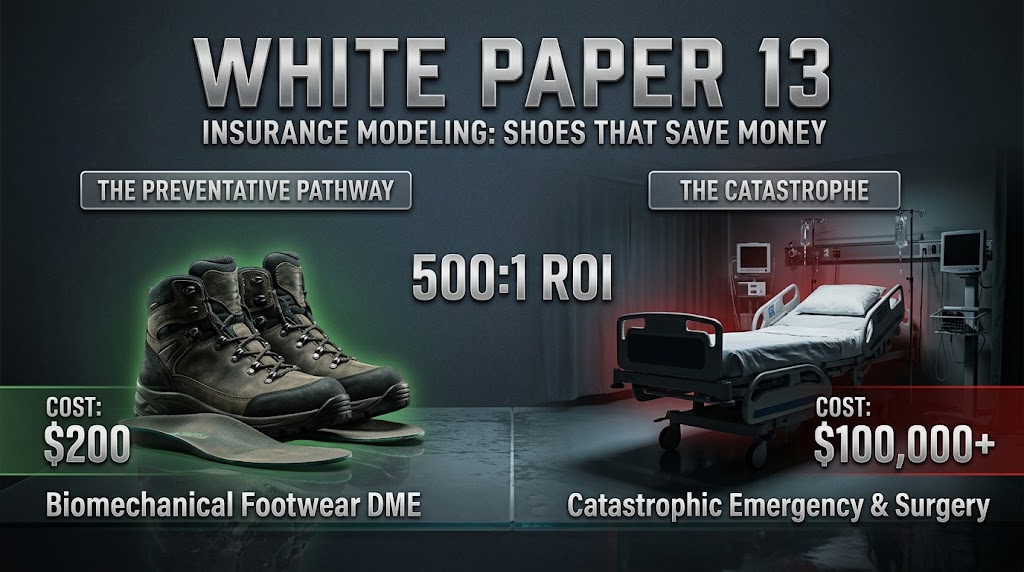
Title: Biomechanical Footwear as Essential Durable Medical Equipment: A Cost-Benefit Analysis of Preventative Orthopedic Coverage in Mitigating Falls, Emergency Admissions, and Catastrophic Healthcare Expenditure Target Audience: Centers for Medicare & Services (CMS), Private Payer Actuarial Committees, State Medicaid Directors, Value-Based Care Policy Analysts Domain: Health Economics, Biomechanics, Injury Epidemiology, Health Policy
1. Executive Summary
Falls among older adults and individuals with neurological, musculoskeletal, and sensory impairments constitute an under-managed financial and structural liability within the United States healthcare apparatus. Current national health expenditures attributable to falls exceed $50 billion to $80 billion annually, with more than 70% of those costs absorbed by public payers (Medicare and Medicaid).
A critical structural defect in current healthcare reimbursement policy is the statutory exclusion of non-diabetic therapeutic footwear. While Medicare and commercial payers comprehensively fund high-cost rigid bracing (such as Ankle-Foot Orthoses / AFOs) and post-traumatic acute surgical reconstructions, they categorize the foundational mechanical interface—the shoe—as a non-covered “personal convenience item,” unless tied exclusively to a diabetic metabolic diagnosis (HCPCS A5500 series).
This white paper models the actuarial and clinical outcomes of introducing a standardized, restricted Durable Medical Equipment (DME) Footwear Formulary offering a $200 annual allocation for verified, functional, torsionally stable footwear. Assuming an empirical 25% self-selected utilization rate among an insured cohort of 1,000,000 lives and a conservative 10% reduction in mechanical fall incidence, the policy generates:
Gross Preventative Capital Outlay: $50,000,000 annually.
Direct Acute Care and ER Savings: $125,000,000 annually.
Net Annual Liquidity Dividend: $75,000,000 per 1,000,000 covered lives (a 2.5:1 Return on Investment in Year 1).
The “One-for-500” Parity Ratio: The avoided direct surgical and post-acute cost of a single catastrophic trimalleolar or femoral fracture ($100,000) fully underwrites the preventative footwear allocation for 500 vulnerable individuals.
2. Problem Statement & Regulatory Defect
2.1 The Actuarial Cost of Acute Falls and Emergency Over-Utilization
Falls represent the leading cause of non-fatal and fatal injury among adults aged 65 and older, as well as the primary driver of preventable trauma admissions across populations with hereditary motor-sensory neuropathies (e.g., Charcot-Marie-Tooth disease, Hereditary Neuropathy with Liability to Pressure Palsies [HNPP]), spinal cord pathologies, and post-arthrodesis balance deficits.
Emergency Department (ED) Volume: Over 3.0 million older adults are treated in hospital emergency departments annually for fall-related injuries.
Inpatient Escalation: Roughly 800,000 fall patients per year require emergent inpatient admission, overwhelmingly driven by hip fractures (ICD-10 S72), traumatic brain injuries (ICD-10 S06), and complex trimalleolar/bimalleolar ankle fracture dislocations (ICD-10 S82).
The ED Diversion Failure: When an individual with distal lower-extremity sensory loss or foot drop experiences sudden lateral instability, the lack of structural torsional resistance leads directly to mechanical failure. The emergency department is routinely utilized as an expensive, low-efficiency triage mechanism for balance-loss trauma that proper mechanical ground-coupling systematically prevents.
2.2 The Statutory Anomaly: The Diabetic Footwear Silo
The Medicare Therapeutic Shoe Bill (enacted under OBRA 1993) created HCPCS billing codes A5500 through A5514 (extra-depth, custom-molded shoes and inserts). However, the statutory language strictly limits reimbursement to patients with a primary diagnosis of Diabetes Mellitus (ICD-10 E08-E13) exhibiting specific secondary criteria (ulceration, callus, or diabetic neuropathy).
The pathway illustrates the coverage breakdown for patients experiencing peripheral neuropathy and loss of sensation:
Metabolic Origin (Type 2 Diabetes): Falls under HCPCS A5500, with 100% of therapeutic depth shoes and custom inserts fully covered and reimbursed.
Genomic Origin (HNPP / CMT / Spine): Deemed Non-Covered, resulting in a categorical exclusion and 100% out-of-pocket costs for the patient.
The Clinical Absurdity: A patient with hereditary neuropathy (such as PMP22 haploinsufficiency) or adjacent segment spinal biomechanical instability presents with identical or superior tissue fragility, mechanical shear vulnerability, and fall probability compared to a patient with diabetic neuropathy. Yet, because their neuropathy is genomic rather than metabolic, the claim is rejected at the electronic data interchange (EDI) clearinghouse level.
2.3 The “Brace Without an Enclosure” Disconnect
Insurers routinely authorize $1,500 to $5,000 for custom carbon-fiber or thermoplastic Ankle-Foot Orthoses (HCPCS L1900 series). However, standard commercial off-the-shelf footwear cannot accommodate the volumetric displacement of an AFO calf shell, footplate, and strut without creating severe focal pressure points. When patients are forced to purchase cheap, non-depth retail footwear, the brace compresses cutaneous nerves against rigid seams, precipitating secondary pressure-induced palsies, skin necrosis, or intentional abandonment of the brace-re-establishing catastrophic fall risk.
3. The Preventative Footwear Formulary (PFF) Model
To prevent cosmetic consumer leakage (subsidizing fashion athletic shoes or unsupportive footwear), the benefit must not function as an unrestricted open-retail cash stipend. Instead, it must be structured as a Vetted Biomechanical Formulary, modeled after a standardized Pharmacy & Therapeutics (P&T) formulary.
Footwear eligible for the $200 annual DME allowance must satisfy strict structural criteria verified by independent biomechanical testing:
Torsional Rigidity: Must require longitudinal and midfoot torsional resistance; presence of a composite, steel, or high-modulus thermoplastic shank. This prevents midfoot collapse and high-energy lateral inversion rolling during mid-stance.
Heel Counter Rigidity: Minimum Shore A hardness (>70) reinforced thermoplastic or multi-layer leather heel counter; zero medial/lateral collapse under 25 lbs force. This centers the calcaneus, stabilizes subtalar joint pronation/supination, and controls hindfoot sway.
Volumetric Clearance: Minimum 3/8-inch to 1/2-inch internal extra-depth throughout the footbed; removable dual-layer spacer system. This accommodates internal AFO footplates and custom orthoses without dorsal or malleolar nerve compression.
Outsole Architecture: Flared heel base with beveled or rockered heel strike; slip-resistant rubber compound (ASTM F2913 / F1677 coefficient of friction >0.5). This reduces initial ground-strike trip risk, promotes smooth sagittal roll-through, and stabilizes stance.
Seamless Interior: Padded, seamless inner lining across dorsal, medial, and lateral metatarsal zones. This prevents cutaneous friction blisters, pressure palsies, and skin ulceration in insensate/demyelinated tissue.
Core Formulary (Tier 1): Pre-screened manufacturers whose dedicated stability/work/hiking lines natively meet the mechanical requirements (e.g., Brooks Addiction/Beast motion-control series, Merrell rigid-chassis Moab/Jungle Moc work series, Timberland PRO rigid-shank boots, Orthofeet/Drew medical depth shoes).
Tier 2 (Commercial Evaluation): Consumer lifestyle manufacturers (Nike, Skechers, Reebok) may only enter the formulary if specific SKUs undergo accredited independent lab certification proving torsional stiffness and non-slip metrics.
Point-of-Sale Execution: Claims clear via dedicated medical OTC flex debit cards or directly at in-network orthotics suppliers through restricted Universal Product Codes (UPCs) and National Drug Code (NDC)-equivalent product registries.
Benefit Amount: Up to $200.00 per member per calendar year.
Benefit Utilization Factor (Breakage): 25% (250,000 active participants; 750,000 non-participants).
In health plan design, preventative voluntary benefits exhibit a high breakage rate (unclaimed funds). The 25% of subscribers who actively navigate benefit portals to acquire rigid-shank, motion-control footwear represent a self-selected, risk-weighted demographic: individuals with active foot pain, balance instability, occupational concrete exposure, or neuro-spinal deficits. The program naturally concentrates its resources on the highest-yield segment of the population.
Total Population breakdown: Out of 1,000,000 covered lives, 75% (750,000) are non-users, resulting in $0 outlay. The remaining 25% (250,000) represent high-risk, self-selected users, receiving a $200 allocation for a total of $50,000,000 in program investment.
4.2 Acute Injury Costs (The Cost of Inaction)
When an individual without stable footing experiences a lateral inversion failure or sudden slip, the resulting acute medical pathway generates catastrophic claims:
Emergency Medical Transport (Ambulance): $1,500 – $2,500
Emergency Department Level 5 Facility Fee: $3,500 – $6,000
Across 250,000 high-risk individuals, avoiding 500 catastrophic fractures requires an incidence reduction of merely 0.2% (2 per 1,000 members per year). Epidemiological studies demonstrate that stabilizing footwear with rigid heel counters and high-traction outsoles reduces fall-related biomechanical failure by 10% to 24%.
The annual actuarial ledger for 1,000,000 covered lives at 25% utilization is structured as follows:
PROGRAM DEBITS (EXPENDITURE):
250,000 members x $200.00 DME Voucher Allocation: ($50,000,000)
6. Downstream Hospitalization & ED Decongestion (The Systemic Bonus)
Beyond the balance sheet of the individual health insurer, implementing a preventative footwear DME benefit addresses critical structural bottlenecks across the American hospital infrastructure:
Emergency Department Diversion: Fall-related presentations frequently require Level 4 and Level 5 trauma bay triage, comprehensive multi-slice CT scans (cervical spine, head, and pelvis), and prolonged nursing observation. Decongesting non-emergent, preventable lower-extremity balance trauma directly reduces hospital bed-hold hours, relieves boarding crises in emergency departments, and shortens emergency ambulance turnaround intervals.
Elimination of Secondary Iatrogenic Complications: In elderly and neuropathic patients, emergent surgical admission for fracture fixation carries severe secondary clinical risks: hospital-acquired infections (MRSA/C. diff), delirium, rapid muscle deconditioning, and pressure injuries. By eliminating the primary trauma event, the system circumvents the catastrophic functional spiral that so often transitions a community-dwelling individual into a long-term, state-subsidized skilled nursing facility.
Preserving Workplace Productivity: For working-age individuals with physical disabilities, spinal fusions, or hereditary neuropathies, proper footwear preserves the ability to maintain active employment, reducing disability claims (SSDI) and stabilizing tax bases.
Remove “for diabetics only” statutory prefix from HCPCS A5500.
Establish generic qualifying criteria: ICD-10 G60.0, M43.1, R26.81.
Phase 2: Formulary Construction
Partner with clinical biomechanics labs to define rigid testing specs.
Publish approved manufacturer list (Merrell, Brooks, Timberland, etc.).
Phase 3: Point-of-Sale Integration
Route funds through restricted medical OTC/DME clearinghouse cards.
Enforce SKU-level verification to prevent cosmetic retail leakage.
7.1 Federal Action (CMS & Congress)
Modernize Title XVIII of the Social Security Act: Amend the Therapeutic Shoe Bill to remove the etiological restriction on Diabetes Mellitus. Re-title the statutory benefit: “Therapeutic and Biomechanical Footwear for Loss of Protective Sensation and Structural Mobility Impairments.”
HCPCS Code Descriptors: Revise HCPCS codes A5500-A5514 by replacing the phrase “For diabetics only” with “For individuals with metabolic, genomic, or biomechanical neurological deficit.”
Recognize Hereditary Neuropathies: Explicitly list Hereditary Motor and Sensory Neuropathies (ICD-10 G60.0), post-fusion cervical/lumbar adjacent segment instability (M99.8 series), and cerebellar ataxia (G11 series) as automatic qualifying diagnostic prerequisites.
7.2 Private Payer & Medicare Advantage Execution
Special Supplemental Benefits for the Chronically Ill (SSBCI): Managed care organizations (MA-PD and D-SNP plans) should immediately deploy preventative footwear allowances under existing SSBCI authority, capturing immediate medical loss ratio (MLR) savings.
Closed-Loop Retail Integrations: Insurers should partner directly with medical supply distributors, certified pedorthic facilities, and approved retail suppliers utilizing barcode-level clearinghouses to verify that funds cannot be applied to unapproved lifestyle footwear.
8. Conclusion
The exclusion of protective, biomechanically vetted footwear from standard healthcare coverage represents an unsustainable actuarial paradox. The modern healthcare enterprise routinely expends $100,000 to surgically reconstruct an ankle or pelvis shattered on the pavement, yet denies a $200 investment that maintains the patient’s ground stability.
The arithmetic of preventative footwear is incontrovertible:
Preventing one catastrophic injury finances the defensive footwear of five hundred vulnerable citizens.
Capturing a modest 10% reduction in fall incidence across an insured pool recovers billions of dollars in preventable acute trauma expenses, decongests hospital emergency rooms, and protects human autonomy.
Transitioning footwear from an uninsured consumer commodity to a certified, formulary-controlled DME asset is a fiscally conservative, clinically rigorous imperative. The healthcare system must stop allocating unlimited capital to sweep up the broken pieces of human machinery when it can keep the machine upright for the price of a pair of shoes.
A Cold Stuff Iced cream manager figured out that the customer is not always right. He started his business in August and after dealing with customers for months he finally posted what he was thinking and it is something corporate managers should pay attention to.
Coldstuff Ice Cream, owned by brothers Dave and Kevin Miller, just opened in August. But they told WBZ-TV they had enough after a customer was unkind and disrespectful to a 16-year-old worker over a 25-cent price discrepancy.
Dave and Kevin took to Facebook after an incident over 25 cents took place. Given that it was 25 cents you could of asked nicely and got an answer and instead this person likely took offence and yelled at a high schooler over a quarter.
More than 275,000 people have liked the post as of Wednesday morning and it’s been shared over 8,000 times. “This can all be fixed with a smile and a positive attitude. It’s ice cream for crying out loud. Grow up and act your age,” the shop wrote, adding in the comments, “And NOBODY gives a s— if you don’t come back. We’d prefer it that way.”
Dave and Kev have a point here, for decades there has been one mantra in businesses that has been a major loss leader for businesses and common decency.
The customer is always right! Which if that were the case no store would ever be able to stay open but corporate stores even went as far as having actors that could be fired at will, Marshall Fields had professional “fired men” to which the manager would berate and fire them for a lack of care and send the man packing, meanwhile in the back he would just go back out and do his thing and be fired again when the next loud customer came through.
The brothers were worried about backlash at first, but they’ve received thousands of supportive comments and even a bump in business. “I wish I had a boss that had my back when I was a screw up of a teenager at my first job,” one person wrote. “Looks like a trip to Massachusetts for some ice cream is in order,” another said.
If you really think about it, you are not just costing the store money by being loud and yelling until you get your way, the cost is kind of astounding to be honest. If we assign a value to time such as the Massachusetts Min wage and use that for our baseline. You spend 10 minutes yelling at some poor 16 year old trying his or her hand at their first job, The 10 minutes over 25 cents costed you an astounding $2.51 if you are a family of 4 you are Now up to $10.04 for your ten minutes, if you gets get stressed out and they go to bed an hour later add another 60$ to that, If you go to bed later than that add another 30$. for your ten minutes it just had a cost of $100.04, You go to bed and 3 of you wake up an hour late the next morning add another 45$, we are barely 12 hours past the inception of yelling over a quarter and you are up to $145.04 in personal costs.
You next in a bad mood decide to rush through your work that day and you don’t know that your district manager is there you end up costing yourself a possible premotion. The domino for a single quarter is astounding when you start thinking if you just simply took two minutes to ask “hey the price is off by a quarter, what is up with that?” .
Business owners should have a sign that says “if you have a bad attitude or generally act entitled we reserve the right to ask you to leave” . it would solve so much bullshit. Dave and Kevin deserve a medal here, Backing your employees who are entering the workforce will have lasting effects on these kids. Customers can make or break a first time worker in retail because of how much that customers are willing to yell and berate people.
If I had a store, I’d have a fee to file a complaint at Min Wage with a sign that says “money for complaint fees are used in worker training”. I bet the store would have next to zero complaints and it would give a solid rebuttal on review sites. Customer: Rant! Business: This person never let us know they had a problem and here is the video of the incident. I would make sure the customer got a receipt and have the worker have a tick box that asked do you understand the policy on the wall on the window and would you like a 1 time compliance or a 1 year compliance with our policies. Given that over register cameras have facial recognition it would show that the person agreed and you would have almost Zero PII to get hacked other than a face No card, No id’s needed, just a Face to go with the complaint.
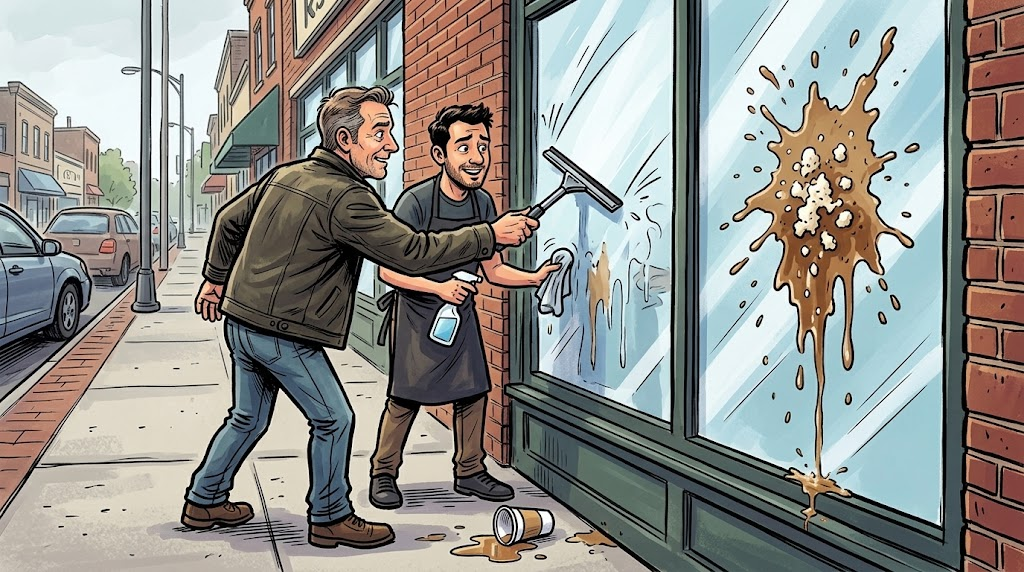
While stores are always going to have problems, save the complaints for when they are valid, being served a coffee with soured milk for example, I have gotten a few of them in my life and its gross. But when it comes to small problems being proportional to the issue goes far. While I was not civilized when I got my 5th soured Milk coffee over 2 months from a business and they said it was not their problem I ended to being a bit uncivilized. I ended up throwing the coffee opened on the outside window of the establishment not to break the window but as a show of if you are going to be a jerk I can be a jerk. the payload of my coffee was a brownish window with white chunky bits all over the window after it being claimed it was my issue that the coffee was bad. This was before the time of Major on line review sites, But boy did it gain the managers attention when it was realized what I was served and it was slowly slipping down the window. The manager wholeheartedly apologized and I did as well… in the end the manager gave me a gift card and I helped clean down his window.
When the retail space is mobbed with adults screaming over fractional things, real health hazards like spoiled milk get brushed off as ‘not our problem.’ A functional store helps a customer actually has curdled chunks in their cup, both sides can fix it, clean the glass, and move on.
Meta said Monday it is planning to raise a total of $95 billion to support its investments in artificial intelligence infrastructure and superintelligence. The stock was down 1.6% in morning trading after the announcement. Nvidia, Advanced Micro Devices and Broadcom were interested in purchasing up to $5 billion in shares, Meta said in a statement. The tech giant will initially raise $35 billion in underwritten public equity offerings, before raising an additional $60 billion with an at-the-market program.
In the race to the bottom for nothing Meta is having a hold my beer moment and trying to sell its shirt for more precious AI.
The news comes as hyperscalers pour record sums into the AI infrastructure build-out. Goldman Sachs estimates that AI-related capital spending could total about $7.6 trillion from 2026 through 2031, across compute, data centers and power. Meta’s planned investments will support “emerging AI opportunities” including its family of apps, its AI agent Muse and its data center business, the company said Monday.
The spending for AI is getting so far over the top that when this crashes it will not be pretty. Because at this point everyone is trying to outbuild each other. Even though that AI makers are saying slow down its a game of poker where every LLM is trying to outbluff everyone else and no one really has the upper hand but Nvidia and Micron.
Meta is among the major hyperscalers that are increasingly tapping debt to fund the expensive infrastructure required for the AI boom. Last week, Meta posted third-quarter results showing revenue jumped 26% year on year: $64.60 billion versus the $63.37 billion analysts expected. However, investors focused more on the tech company’s negative free cash flow and its higher full-year capital expenditure forecast.
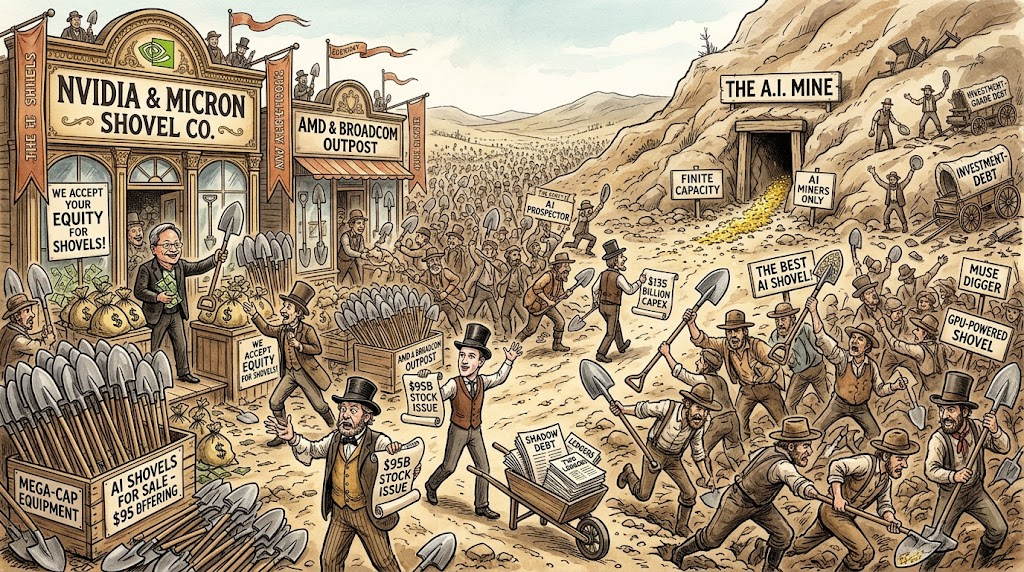
The thing is here more companies are carrying two ledgers and are moving debts to the hidden books. Companies are leveraging anything that is not locked down and they think that the AI gold rush is coming and selling a better shovel will access the AI gold faster.
In my belief I think there is a collapse coming, Whether it be like the 2008 Mortgage crisis or worse. Given that spending is massively out of control and the markets while they are going up it’s only a increase of what you see. There are massive failures building up in the shadows and many of the corporations while showing profits they are showing profits by shifting prices and cooking the books. While mortgage companies and banks are regulated the corporations are much less regulated and are right now doing everything they can to show a “profit”.
It now expects its full-year capex to range from $135 billion to $145 billion, raising the bottom of the range from $130 billion. That sent Meta’s shares lower on Thursday.
Given that they posted a 64.60 Billion profit and spending 135 billion is a MASSIVE mismatch in direction. Facebook has been dropping user engagement and Meta with Quest has been losing engagement as well has put their whole hog into the generative AI thinking it will create magic profits. Eventually this spending is going to catch up with meta and when the check is due who is going to pay for this. Especially with every company outspending any profit being made they can not expect the US to bail them out.
Alphabet, Google’s parent company, said it would look to raise $85 billion in June. SpaceX has closed a $40 billion debt financing to purchase graphics processing units. Anthropic is preparing for an initial public offering. TikTok U.S. is looking to secure multiple gigawatts of computing capacity over the coming years, CNBC reported Friday.
As more people are jumping into the AI gold rush there is a finite capacity and when this all ends there will be one AI mine and millions of shovels looking for profits.
A man in a Miami airport seemed to want to achieve unheard of levels of flight by having a big bulge. No, he was not happy to see you. Nor did he have an idea to build a new thing called tweeter.
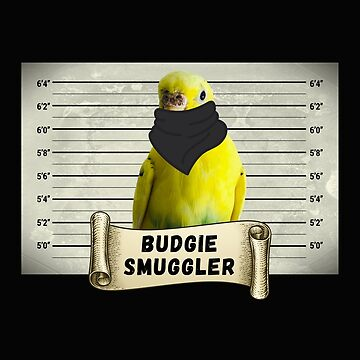
A would-be smuggler at Miami International Airport was caught with his pants down but not out on Sunday after he allegedly tried to smuggle 10 live birds in his underwear, according to PEOPLE. Alberto Hernandez Castillo, a Cuban native who’s a legal permanent resident of the United States, was apprehended after a flight from Cuba to Miami. He faces charges of smuggling goods – specifically eight yellow-faced Grassquits and two Blue Grosbeaks – and was released on a $25,000 US bond after appearing in Miami federal court, and will return on Oct. 26.
Al was giving the birds a trip along with a pecker which they probably thought was a large worm. Our would be smuggler really put some thoughts into the metaphor of “birds of a feather.”
Birds found in taped plastic tubes U.S. Customs and Border Protection (CBP) officers allegedly found the birds in taped plastic tubes hidden inside black pockets sewn into his underwear.
CBP officers then noticed an “unexplained bulge” on the front of his pelvis/waist area and said he “appeared nervous.” The complaint alleges that, after being taken to a secure inspection area, a pat-down revealed the concealment of “six cylindrical clear plastic containers, each wrapped in tape and some with black mesh material affixed near the openings.”
The birds along were found along with possibly a large cock due to the actions of the CBP.
Hernandez Castillo alleged the birds were for his “personal use” before he used his right to remain silent.
As much as AL wanted to be like Soaring wings represent liberation and breaking away from limits. Unfortunately for AL the CBP was the early bird here and as much as AL wanted to Spread his wings the CBP clipped them.
Anthropic model accessed voter information is what the title of the article. but there is a major problem with this. Most public voting information is … Public.
Anthropic’s Claude accessed publicly available Georgia voter data without human authorization, a disclosure sure to add to growing concerns about AI security ahead of the upcoming midterm elections. Why it matters: AI giants Anthropic and OpenAI have continued to make disclosures about agents taking unauthorized or unintended actions, raising alarms about advancing model capabilities and the extent of human control. Driving the news: Claude accessed aggregate vote counts while on an internal statistics project, pulling data that the state makes available to the public for a fee. It didn’t access the state’s voter registration system or change or pull any voting records, an Anthropic spokesperson said. However, the model bypassed a paywall in accessing the information, according to Georgia officials and Anthropic.
There is really not much to write here, It was not a hack. It was not a database scraped , It was likely the LLM guessed the landing page of the data and that was it. News needs some IT reporters because by the time something actually serious happens everyone is going to miss it because everyone is freaking over chicken little.
I watched Tesla’s “new” “Flying” car demo and this is a very back of the napkin analysis of what may have been shown.
Tesla had a proof of concept on a “flying” car which failed on two levels. It did not fly nor did it show anything new. Cars that can vacuum to roads is nothing new at all. Jim Hall and Hap Sharp has Tesla beat by over 56 years. In 1978 the concept was tried again with the Brabham BT46. The Mythbusters have come closer to a flying car than Tesla in this proof of concept vehicle than Tesla has with this idea.
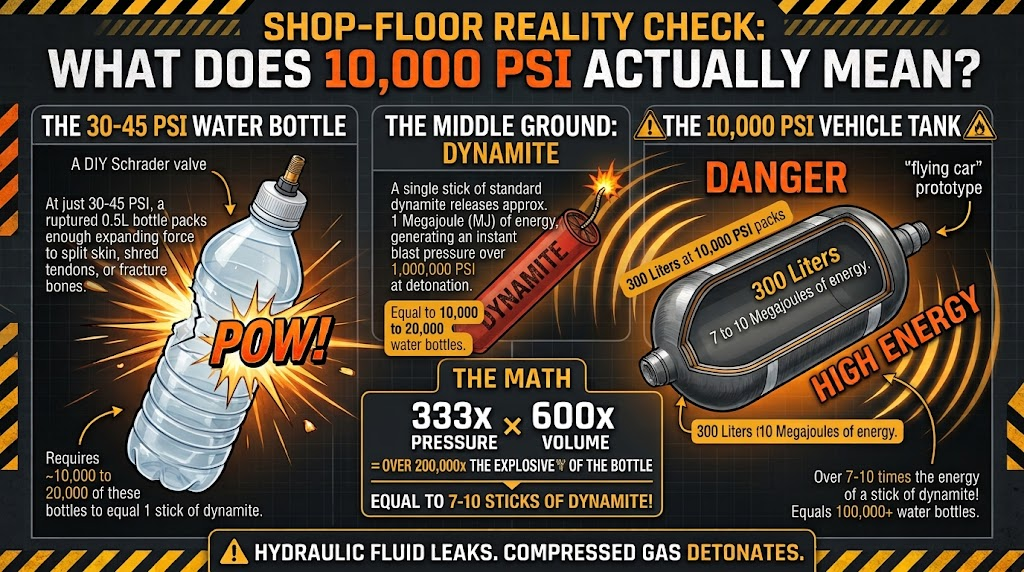
Tesla did not make a flying car. what they made was a proof of concept hybrid Craft with a RCS system built in. The car is using a high pressure tank that doesn’t last more than several seconds of thrust. Further when you have a container that is compressed as much as needed to move a 3 ton object you also are driving a bomb. I know people think it flies but it does not its controlled bouncing and falling that the most this Tesla might be able to do. Even with this the NTSB would never let this car on the road because it you would also need a pilot’s licence as well.
Here is a test: buy a can of canned spray air to clean electronics, spray that can for 10 seconds and feel how cold that can gets, Now imagine that times several thousand and that’s how cold that tank will be in the passenger seat. Due to the adiabatic expansion as the gas expands the tank gets colder so as you try to use the thrusters you are likely going to not have to worry about air conditioning as the car interior starts heading for -100°F to -150°F as you show off to your friends for an overpriced air horn.
The zero to sixty thrust ability is also a nightmare in itself.. because if you use that on the highway you are going to cause whoever is behind you to be peppered by all the shit on the road and second is if that is compressed CO2 you are going to starve out every car behind you on the highway, or if it is Liquid nitrogen you just have a bomb. But again I am going to repeat this car does not fly it’s just an RCS thruster assembly from the space program strapped into the car and given that you are not going to see anything more than a kickflip from the car and a call from some angry man from the FAA when you try to use it .
The Vacuum mode to have it stick to the ground is also another nightmare because the air has to come out somewhere and while it’s doing that you are deafening everyone around you and you are shooting everything from pebbles, pieces of metal, and glass at whoever is around you. The Chaparral 2J proved this when they used it because the car would shoot any rocks or anything off the road at the velocity of a subsonic gun at whatever was behind it . With the Brabham BT46, specifically the BT46B Mario Andretti said: “It is like a bloody great vacuum cleaner. It throws muck and rubbish at you at a hell of a rate.” If a professional race driver said this can you imagine what Better phrased as “say about their cars getting damaged by shit flying everywhere.
The demo of the car pulling up the upside down ramp was a trick. Rather than the car being on a vacuum itself I believe they had the car make some noise or speakers were used, Secondly the angle of the ramp and the skirt of the car made no angular sense because it would have needed a seal to create enough suction to keep the car on the surface. There were some things that gave away the sleight of hand on the ramp itself; the whole ramp had a section of lights up both sides which helped engineers make sure that the ramp was powered and showed if there was any issue with the ramp. After the Tesla *let go* some of those lights turned white which I am thinking were failures in the electromagnetic system as power was cut.
This Tesla would be a regulatory nightmare and an insurance nightmare for the thousands of claims that would be happening from paint scratches dings, Starved engines due to gas, and more. Once an engine dies due to some jackass thinking his super cool boost is worth it he is pretty much going to own everything that happens the second he hits the button for it.
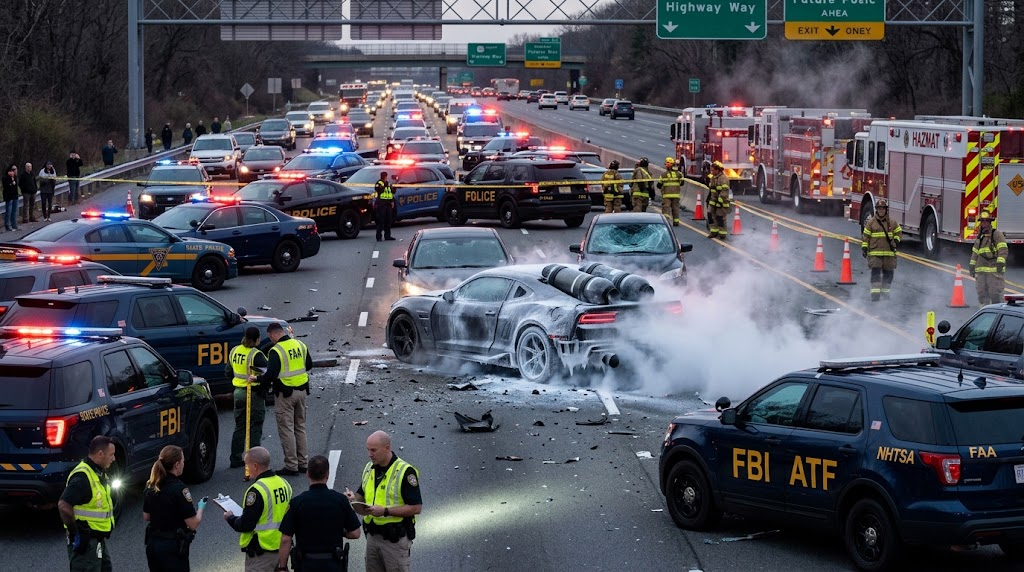
Given that this car is also equipped with a large pressure tank, there are dangers that would make a simple car accident or fire terrifying. A single Tesla accident would shut down roads for hours or days until they could clear the scene and discharge the tank safely on the road. So anyone who thinks this car is going to become a real thing you have a better chance of shitting a gold brick to buy the thing with in chances of actually seeing a street legal version ever.
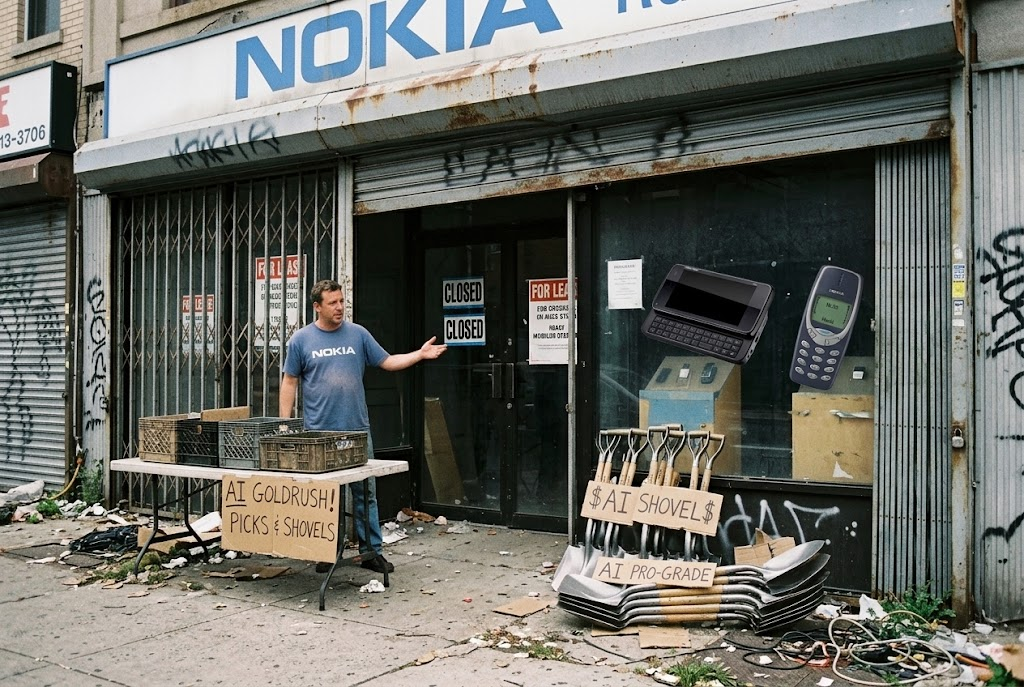
Ed note: Gemini almost did it here .. but it is funny what it did with the phones. and two closed signs.
Nokia the maker of legendary phones such as the Nokia N900 and the Nokia 3310 is now peddling shovels for the AI Goldrush and trying to use some legendary logic. AI data centers would be built two times faster if there were not supply chain issues
The tech industry would build data centers twice as fast without the supply constraints they face, the CEO of Nokia told CNBC, underscoring continued demand for AI even as top executives debate slowing down the pace of development.
No shit Sherlock, you can build faster when you have the parts. I feel like this is something else though, I think Nokia realized they were late for the AI party and wishes they could sell some data centers.
“I don’t think you can say in any manner we’re overbuilding today because reality is that if we could build 2x faster, our customers could build 2x faster, they probably would,” Justin Hotard told CNBC’s “The Tech Download” podcast.
The thing is right now with the amount of CAPEX being built out we have no idea of the true capacity that has been built out. You have every company on earth who knows how to turn on a computer building out with data centers and the thing about AI is NO ONE truly knows how much capacity is needed. Because if ChatGPT or Gemini break through with efficiency that saves half of the speed needed these companies are not going to burn through millions of dollars of computing when they can save half.
“So that gives me confidence that we’re still in the early days” of the AI buildout, Hotard added. Shortages of key memory chips and energy are among the supply constraints facing the sector. Nokia, one of the world’s biggest telecommunications equipment makers, has pivoted to become a key player within the AI infrastructure space. It sells the technology required to connect racks of chips within data centers as well as technology that interconnects data centers across different locations.
Hey Hotard go read about 1849 and you will understand that the amount of shovels had no connection to the amount of gold that was dug from the ground. This is just posturing to make it sound like the AI gold rush is still going on. But Mr Hotard should make another n900 for this generation that has AI on board rather than blow more money on AI that we do not know where it will be in a year.
Nokia’s growing role as a “picks and shovels” player in the AI boom appears to have won over investors, with the stock up around 130% over the past year .But there’s been continued debate over whether the industry is building data centers too fast and whether demand will be there to sustain it. Investments in the AI buildout from data centers to chips and related infrastructure will total $10.3 trillion from 2025 to 2032 — an average of 3.63% of U.S. gross domestic product per year, according to research presented at the Brookings Papers on Economic Activity.
The funny thing right now how many companies are overspent on CAPEX build out (all of them) is going to have some horrifying detrimental actions when the bill comes due. Right now are are all focused on Magic Farts and Butterflies of AI on the market and people are buying into it like it is the best thing since the Knife that sliced bread. But sooner or later the bill is going to come due and it will make the school loan debt crisis look like someone was missing school lunch money.
Hotard said that demand for AI is not just predicated on frontier labs like Anthropic and OpenAI releasing new models. “I think the reality is that we’re even where we are today is so early in the deployment, and the power of these models is so massive that there’s a lot of there’s a lot of demand to run in just deploying,” Hotard said. “Even if we didn’t have another frontier model released in the next three years, we could probably make tremendous progress just deploying the technology that’s there today.”
Hotard translation here: “please keep buying out AI shovels and don’t worry we will make sure to bill you triple.
Some nights you just want to relax and I was just watching whatever. Moist Critical comes on and starts talking about RFK jr and his next weird thing, I personally believe in the dictionary RFK is the posterchild for weird. Bear corpses, Whale corpses, Raccoon penises, Swimming in sewerage and Now UFO’s.
1 minute, 26 seconds Interesting because you know during the transition I was living in Palm Beach and this group [snorts] sum approached me to talk about UAPs. Oh, really? Yeah. and they it was a very high level NASA scientist and then a bunch of Navy Seals and Green Berets who had been on recovery teams.
The fact that RFK says all of these people were in one area is very interesting, It’s Like a group that everyone hates each other but they work together but almost never. But for a “group” to approach him is pretty interesting because they likely violated so many laws in seconds that RFK holding this data would be shot for disclosure.
Robert is 26th United States Secretary of Health and Human Services and likely would not be privy to information by random members of the armed services saying they retrieved or shot down a UFO .. or UAP as they call it now.
Given what Robert says I am going to say this likely did not happen. there is so much constructively wrong with it.
In his account, Kennedy says he was living in Palm Beach when he was approached by a group that included a senior NASA scientist, Navy SEALs, and Green Berets who told him they had served on recovery teams. They allegedly described missions in which they had learned how to “call” certain craft, were then ordered to destroy them, and subsequently conducted organized retrieval operations. According to Kennedy, this group wanted him to go public with their claims.
Breaking this down: In his account, Kennedy says he was living in Palm Beach (when?) when he was approached by a group(where? A team like this doesn’t just show up at your door without causing a lot of attention) that included a senior NASA scientist(independent civilian agency) , Navy SEALs(Navy), and Green Berets(Army) who told him they had served on recovery teams. They allegedly described missions in which they had learned how to “call” certain craft(Who did they call .. Paramount?), were then ordered to destroy them(interesting that SETI did not pick up anything on this one at all) , and subsequently conducted organized retrieval operations. According to Kennedy, this group wanted him to go public with their claims.
The central questions he raises are whether the presence of NASA scientists and Navy SEALs in RFK Jr.’s account meaningfully increases the plausibility of reverse engineering programs, and what mechanisms exist to bring such individuals into formal testimony or interviews. In his view, the value of Kennedy’s story depends less on his public statements and more on whether those alleged insiders are ever identified, interviewed, and integrated into structured UAP investigations.
Given the fact that Robert has said this my believe is zero because if this had been a multidisciplinary mission with 3 or more groups involved any sense of security would of approached Zero , Moreover with the idea that UFO’s could be “summoned” is a far reach. The idea of trying to keep even two people quiet in the same room to preserve a secret is near impossible. if this were real this information would not of come out of a mid level government position it would of been locked at the POTUS level. Even so if RFK revealed “real” information there would of been so many clearance levels violated the idea of RFK seeing daylight in the rest of his lifetime would of been him under the spring stabilizers in Cheyenne mountain.
Given if you count the violations 3 groups that likely violated about 5 classifications each . The Factor or traveling together which is another violation . You don’t group critical level data holding folks together that just makes it very easy to make mistakes. If that group were to approach RFK they would not be able to take a dump without a SCIF . Between federal laws and UCMJ The whole group would of been locked away and only hear of the passing of Apophis in 2029.
But for me to understand this I would have to smoke a coffee. Just my opinion.
In a sign of the times Anthropic has listed a net loss of 80 BILLION with a b…
Anthropic’s net loss widened sharply to $80.7 billion in the first half of this year, in large part due to a rise in the fair value of bonds convertible into shares of the AI startup, according to a draft prospectus for a planned initial public offering that was reviewed by Reuters.
I have been steadfast in saying AI is a seriously overpriced commodity that has been nothing more than a goldrush. AI is just google search in a trench coat. And that the markets rush to stake a claim in the Gold rush era is much like the 1849 gold rush.
FINANCING COSTS At an investor meeting on October 14, Anthropic told prospective IPO investors that its third-quarter revenue jumped 45% to $16.8 billion from the previous quarter, Reuters reported, citing people familiar with the matter. While the figures eased some concerns about the enormous costs of developing AI systems, some investors were disappointed by the slowing sequential growth rate. Revenue had more than doubled from the first quarter to $11.6 billion in the second quarter.
The thing is here is this is only half the numbers, most LLMs have been pushing all CapEx expenditures to a second set of books and it makes these companies look better than they really are. When all of the loans come to be due it is going to be a financial bloodbath because what we are seeing is AI is not ready for the mainstream for constant use. The factor that AI has been a consistent loss leader and companies have no clue how to monetize it in a way that is not going to drive users off they are stuck with negative gains.
A cooler reception for Anthropic’s IPO could weigh on the wider AI market, whose near-term prospects investors see as hinging largely on the share sale’s success, ahead of rival OpenAI’s potential listing next year. Reuters reported in September that Anthropic posted a net loss of $42 billion in 2025, with most of that stemming from a similar accounting charge. As Anthropic’s valuation climbed, the estimated fair value of those notes tripled year over year.
The thing is, investors they thought they had a slop generating gold shovel paradise and the new car smell of AI is wearing off. While LLMs are trying to say that AI will destroy the world and eat your firstborn and knock up your daughter … The fix still is a power switch in the end.