Tag: Return on Investment (ROI)
FAA finally deletes the save icon 💾

Originally written November 7, 2026; pushed live ahead of schedule following the November 13 FAA ground stop
At times we move incredibly fast with technology; other times we move fucking slow with tech, like Rhode Island still using COBOL (still). But the one thing about government and tech – they hate change and if they could keep to punch card computing they would try.
The Federal Aviation Administration still uses computers that require floppy disks. But those are finally on the way out within the next few years. Yes, it’s still 2026, and yes, you read that right: The FAA – the agency responsible for overseeing aviation safety in the US – is finally getting rid of four systems dating back to the 1980s that remain in use at more than 400 facilities around the country, the agency announced on Thursday.
The Register seems surprised by the revelation, but they missed something: while the floppy is likely 1980s tech, behind that is likely 1960s tech that has just been built over and over. Given a brand new system would bring the airlines to a halt they cannot shut down these systems. But the FAA and Government particularly love to say “upgrade this but don’t touch it!”
“Good news America: floppy disks are out, 21st century tech is in,” Transportation Secretary Sean Duffy said in the FAA’s announcement. Only a few decades late, Sean, but we’re sure the flying public appreciates it.
The way this comes across from Duffy is this:

Anyone who has watched Futurama knows to be terrified by that statement.
E-IDS is replacing four legacy systems: Information Display System 4, used to track weather and operational info; the Automated Surface Observing System Controller Equipment Information Display System, which also relays weather information; the NAS Information Display System, which relays information about airports and other airspace conditions; and the En Route Information Display System (ERIDS), which handles information about flights. The FAA said E-IDS will improve how Pilot Reports and Notices to Airmen (NOTAMs) are collected and distributed. The agency has had its share of air traffic control SNAFUs, including one in 2023 that temporarily halted domestic flight departures nationwide after someone accidentally deleted a file from the NOTAM system.
The thing is, most governments miss the upgrade strategy I am about to propose: don’t be like Rhode Island and throw a wrapper over an old system like a cheap coat of paint. Instead Mirror the system and let the mirror be updated in real time and build your new upgrade system in real time, Let the mirror image system run on the side of the existing system and once both systems agree on the data, then you optimize. DO NOT write a cheesy emulator to parse the information.

The FAA said it has already lined up five facilities to receive E-IDS upgrades: airports in Atlantic City, Nashville, and Rochester, New York, along with data processing hubs in Atlanta and Salt Lake City. The agency plans to install the system at 435 sites by the end of 2028. That 2028 deadline echoes the ambitious three-year timetable Duffy laid out last year for overhauling the nation’s air traffic control system. Aside from the four systems E-IDS will replace, the FAA has a lot of outdated technology, with the Government Accountability Office saying in 2024 that 51 of the agency’s 138 ATC systems were unsustainable due to lack of parts and funding to sustain or replace them.
The sad thing here is that the FAA was sourcing 30+ year old hardware from anywhere they could find it to keep these systems running. this is another place where government and municipal systems fail. They will go out and source a 25-year-old New Old Stock (NOS) device and hope it works because the thing cost $400 to find $500 to install and $1000 to fine tune rather than spend the $2000 for a brand new system. This is why I say they should spend the $2,000 and run the target upgrade system in parallel.
“It will modernize our air traffic control system, replace crumbling aviation infrastructure, and build world-class airports across the country,” they said. In other words, the FAA wants to get rid of floppy disks, but it’s probably not accurate to say they’re “out,” as Duffy put it.
The funny thing, if you read this article carefully, is that Duffy is already doing a victory lap before they have even installed these upgrades on a live system—which brings Professor Farnsworth right back to mind. They are going to try to install these systems and end up fucking things up for days. I was on the receiving end of airline computer meltdowns back in 2006–2007, and it was an absolute nightmare.

Update: as expected the entire FAA went down for unknown reasons this evening at 11/13/26 (who rolls shit out on Friday the 13th?)

MESSAGE: |EVENT TIME: 13/2053 – 14/0400 DUE TO EXTRAORDINARY CIRCUMSTANCES AND FOR REASONS OF SAFETY. ATTENTION ALL AIRCRAFT OPERATORS, BY ORDER OF THE FEDERAL AVIATION COMMAND CENTER ALL AIRPORTS ARE GROUND STOPPED. ALL DEPARTING TRAFFIC SHOULD REMAIN GROUND STOPPED UNTIL FURTHER NOTICE. INBOUND INTERNATIONAL FLIGHTS WILL BE MANAGED ON A CASE BY CASE BASIS.
EFFECTIVE TIME: |132054-140430
SIGNATURE: |26/11/13 20:54
- Tuesday, November 10th: FAA: “The Strategic Management of Airspace, Routes and Trajectories (SMART) system is expanding across the nation. After a successful initial rollout to the National Capital Region in September, the FAA will now use SMART in the airspace of all 22 centers across the country to reduce delays, reduce fuel consumption and improve the travel experience for the flying public.”
- Friday, November 13th: FAA Nationwide Ground Stop
- ABC: This is only the 3rd time this has happened since 9/11
- 4:19pm EST: There are currently 3,100 airborne aircraft bound for US airports amid nationwide ground stop. No additional aircraft are taking off at this time. (FlightRadar24)
- 5:02pm EST: There has been a temporary telecommunications outage – out of an abundance of caution all flights have been halted. Every flight has been accounted for and international flights will be handled on a case by case basis. (FAA)
- 5:34pm EST: Air Space Intelligence, the AI tech startup that is a vendor for the FAA on its new SMART system: “The current ground stop is not based on or a result of the SMART system, any product of ASI or our integration with FAA and ATC.”
- 6:00pm EST: San Francisco International Airport announces Pacific-bound flights have been cleared to leave, including to Hawaii and Asia.
- 6:15pm EST: NBC News: At Newark Liberty International Airport (EWR), personnel in the control tower said the situation is “a whole mess right now,” according to LiveATC. “We’re running out of space” and “there’s significant gate issues” were comments also heard on the live audio feed.
✅ 8:20pm EST: CBS News: National ground stop has been lifted. Expect a whole lot of residual delays/cancelations and some start and stops along the way tonight and tomorrow.
From:
The Register – US air traffic control enters the 21st century, starts to abandon floppy disks
White Paper 13: The 1:500 Parity Ratio Modeling Preventative Footwear as Durable Medical Equipment to Mitigate Acute Trauma Liabilities
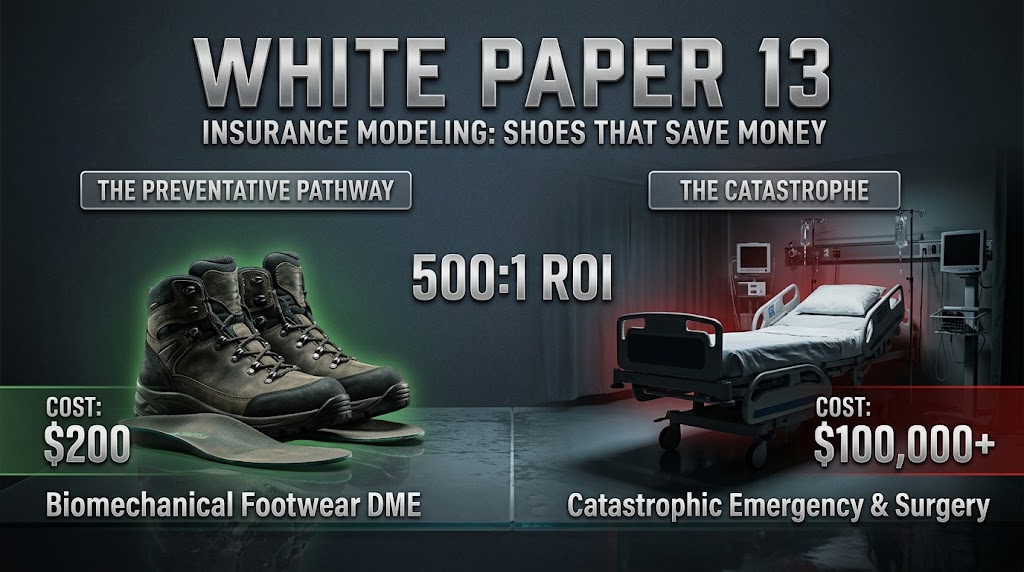
Title: Biomechanical Footwear as Essential Durable Medical Equipment: A Cost-Benefit Analysis of Preventative Orthopedic Coverage in Mitigating Falls, Emergency Admissions, and Catastrophic Healthcare Expenditure
Target Audience: Centers for Medicare & Services (CMS), Private Payer Actuarial Committees, State Medicaid Directors, Value-Based Care Policy Analysts
Domain: Health Economics, Biomechanics, Injury Epidemiology, Health Policy
1. Executive Summary
Falls among older adults and individuals with neurological, musculoskeletal, and sensory impairments constitute an under-managed financial and structural liability within the United States healthcare apparatus. Current national health expenditures attributable to falls exceed $50 billion to $80 billion annually, with more than 70% of those costs absorbed by public payers (Medicare and Medicaid).
A critical structural defect in current healthcare reimbursement policy is the statutory exclusion of non-diabetic therapeutic footwear. While Medicare and commercial payers comprehensively fund high-cost rigid bracing (such as Ankle-Foot Orthoses / AFOs) and post-traumatic acute surgical reconstructions, they categorize the foundational mechanical interface—the shoe—as a non-covered “personal convenience item,” unless tied exclusively to a diabetic metabolic diagnosis (HCPCS A5500 series).
This white paper models the actuarial and clinical outcomes of introducing a standardized, restricted Durable Medical Equipment (DME) Footwear Formulary offering a $200 annual allocation for verified, functional, torsionally stable footwear. Assuming an empirical 25% self-selected utilization rate among an insured cohort of 1,000,000 lives and a conservative 10% reduction in mechanical fall incidence, the policy generates:
- Gross Preventative Capital Outlay: $50,000,000 annually.
- Direct Acute Care and ER Savings: $125,000,000 annually.
- Net Annual Liquidity Dividend: $75,000,000 per 1,000,000 covered lives (a 2.5:1 Return on Investment in Year 1).
- The “One-for-500” Parity Ratio: The avoided direct surgical and post-acute cost of a single catastrophic trimalleolar or femoral fracture ($100,000) fully underwrites the preventative footwear allocation for 500 vulnerable individuals.
2. Problem Statement & Regulatory Defect
2.1 The Actuarial Cost of Acute Falls and Emergency Over-Utilization
Falls represent the leading cause of non-fatal and fatal injury among adults aged 65 and older, as well as the primary driver of preventable trauma admissions across populations with hereditary motor-sensory neuropathies (e.g., Charcot-Marie-Tooth disease, Hereditary Neuropathy with Liability to Pressure Palsies [HNPP]), spinal cord pathologies, and post-arthrodesis balance deficits.
- Emergency Department (ED) Volume: Over 3.0 million older adults are treated in hospital emergency departments annually for fall-related injuries.
- Inpatient Escalation: Roughly 800,000 fall patients per year require emergent inpatient admission, overwhelmingly driven by hip fractures (ICD-10 S72), traumatic brain injuries (ICD-10 S06), and complex trimalleolar/bimalleolar ankle fracture dislocations (ICD-10 S82).
- The ED Diversion Failure: When an individual with distal lower-extremity sensory loss or foot drop experiences sudden lateral instability, the lack of structural torsional resistance leads directly to mechanical failure. The emergency department is routinely utilized as an expensive, low-efficiency triage mechanism for balance-loss trauma that proper mechanical ground-coupling systematically prevents.
2.2 The Statutory Anomaly: The Diabetic Footwear Silo
The Medicare Therapeutic Shoe Bill (enacted under OBRA 1993) created HCPCS billing codes A5500 through A5514 (extra-depth, custom-molded shoes and inserts). However, the statutory language strictly limits reimbursement to patients with a primary diagnosis of Diabetes Mellitus (ICD-10 E08-E13) exhibiting specific secondary criteria (ulceration, callus, or diabetic neuropathy).
The pathway illustrates the coverage breakdown for patients experiencing peripheral neuropathy and loss of sensation:
- Metabolic Origin (Type 2 Diabetes): Falls under HCPCS A5500, with 100% of therapeutic depth shoes and custom inserts fully covered and reimbursed.
- Genomic Origin (HNPP / CMT / Spine): Deemed Non-Covered, resulting in a categorical exclusion and 100% out-of-pocket costs for the patient.
The Clinical Absurdity: A patient with hereditary neuropathy (such as PMP22 haploinsufficiency) or adjacent segment spinal biomechanical instability presents with identical or superior tissue fragility, mechanical shear vulnerability, and fall probability compared to a patient with diabetic neuropathy. Yet, because their neuropathy is genomic rather than metabolic, the claim is rejected at the electronic data interchange (EDI) clearinghouse level.
2.3 The “Brace Without an Enclosure” Disconnect
Insurers routinely authorize $1,500 to $5,000 for custom carbon-fiber or thermoplastic Ankle-Foot Orthoses (HCPCS L1900 series). However, standard commercial off-the-shelf footwear cannot accommodate the volumetric displacement of an AFO calf shell, footplate, and strut without creating severe focal pressure points. When patients are forced to purchase cheap, non-depth retail footwear, the brace compresses cutaneous nerves against rigid seams, precipitating secondary pressure-induced palsies, skin necrosis, or intentional abandonment of the brace-re-establishing catastrophic fall risk.
3. The Preventative Footwear Formulary (PFF) Model
To prevent cosmetic consumer leakage (subsidizing fashion athletic shoes or unsupportive footwear), the benefit must not function as an unrestricted open-retail cash stipend. Instead, it must be structured as a Vetted Biomechanical Formulary, modeled after a standardized Pharmacy & Therapeutics (P&T) formulary.
3.1 Closed Technical Specifications (Eligibility Matrix)
Footwear eligible for the $200 annual DME allowance must satisfy strict structural criteria verified by independent biomechanical testing:
- Torsional Rigidity: Must require longitudinal and midfoot torsional resistance; presence of a composite, steel, or high-modulus thermoplastic shank. This prevents midfoot collapse and high-energy lateral inversion rolling during mid-stance.
- Heel Counter Rigidity: Minimum Shore A hardness (>70) reinforced thermoplastic or multi-layer leather heel counter; zero medial/lateral collapse under 25 lbs force. This centers the calcaneus, stabilizes subtalar joint pronation/supination, and controls hindfoot sway.
- Volumetric Clearance: Minimum 3/8-inch to 1/2-inch internal extra-depth throughout the footbed; removable dual-layer spacer system. This accommodates internal AFO footplates and custom orthoses without dorsal or malleolar nerve compression.
- Outsole Architecture: Flared heel base with beveled or rockered heel strike; slip-resistant rubber compound (ASTM F2913 / F1677 coefficient of friction >0.5). This reduces initial ground-strike trip risk, promotes smooth sagittal roll-through, and stabilizes stance.
- Seamless Interior: Padded, seamless inner lining across dorsal, medial, and lateral metatarsal zones. This prevents cutaneous friction blisters, pressure palsies, and skin ulceration in insensate/demyelinated tissue.
3.2 Manufacturer Certification & Commercial Access
- Core Formulary (Tier 1): Pre-screened manufacturers whose dedicated stability/work/hiking lines natively meet the mechanical requirements (e.g., Brooks Addiction/Beast motion-control series, Merrell rigid-chassis Moab/Jungle Moc work series, Timberland PRO rigid-shank boots, Orthofeet/Drew medical depth shoes).
- Tier 2 (Commercial Evaluation): Consumer lifestyle manufacturers (Nike, Skechers, Reebok) may only enter the formulary if specific SKUs undergo accredited independent lab certification proving torsional stiffness and non-slip metrics.
- Point-of-Sale Execution: Claims clear via dedicated medical OTC flex debit cards or directly at in-network orthotics suppliers through restricted Universal Product Codes (UPCs) and National Drug Code (NDC)-equivalent product registries.
4. Health Economic & Actuarial Model
4.1 Cohort Architecture & The Breakage Principle
- Base Risk Pool: 1,000,000 covered commercial / Medicare Advantage / Managed Medicaid lives.
- Benefit Amount: Up to $200.00 per member per calendar year.
- Benefit Utilization Factor (Breakage): 25% (250,000 active participants; 750,000 non-participants).
In health plan design, preventative voluntary benefits exhibit a high breakage rate (unclaimed funds). The 25% of subscribers who actively navigate benefit portals to acquire rigid-shank, motion-control footwear represent a self-selected, risk-weighted demographic: individuals with active foot pain, balance instability, occupational concrete exposure, or neuro-spinal deficits. The program naturally concentrates its resources on the highest-yield segment of the population.
Total Population breakdown: Out of 1,000,000 covered lives, 75% (750,000) are non-users, resulting in $0 outlay. The remaining 25% (250,000) represent high-risk, self-selected users, receiving a $200 allocation for a total of $50,000,000 in program investment.
4.2 Acute Injury Costs (The Cost of Inaction)
When an individual without stable footing experiences a lateral inversion failure or sudden slip, the resulting acute medical pathway generates catastrophic claims:
- Emergency Medical Transport (Ambulance): $1,500 – $2,500
- Emergency Department Level 5 Facility Fee: $3,500 – $6,000
- Diagnostic Imaging (CT / Bi-Planar X-Ray): $2,000 – $4,500
- Surgical Intervention (ORIF Ankle/Femur): $45,000 – $65,000
- Anesthesia & Inpatient Surgical Suite Fees: $12,000 – $18,000
- Inpatient Recovery (3-5 Days Acute Bed): $15,000 – $25,000
- Post-Acute Skilled Nursing Facility (SNF): $10,000 – $20,000
- Outpatient Physical/Occupational Therapy: $3,000 – $6,000
- TOTAL DIRECT EPISODE CLAIMS COST: $92,000 – $147,000 (Median: ~$100,000)
5. Cost-to-Savings Analysis
5.1 The 1-to-500 Parity Ratio
The economic viability of preventative footwear rests on an unprecedented asymmetric capital ratio:
- Single Catastrophic Fall Cost: $100,000
- Footwear DME Allocation: $200
- Parity Ratio: $100,000 / $200 = 500 : 1
The 1:500 Axiom: Preventing exactly one catastrophic surgical trauma admission fully amortizes the hardware subsidy for five hundred individuals.
5.2 Population Ledger (1 Million Covered Lives)
To achieve break-even on a $50,000,000 gross program expenditure across 250,000 active participants:
- Break-Even Calculation: $50,000,000 / $100,000 = 500 Catastrophic Events
Across 250,000 high-risk individuals, avoiding 500 catastrophic fractures requires an incidence reduction of merely 0.2% (2 per 1,000 members per year). Epidemiological studies demonstrate that stabilizing footwear with rigid heel counters and high-traction outsoles reduces fall-related biomechanical failure by 10% to 24%.
The annual actuarial ledger for 1,000,000 covered lives at 25% utilization is structured as follows:
- PROGRAM DEBITS (EXPENDITURE):
- 250,000 members x $200.00 DME Voucher Allocation: ($50,000,000)
- Administrative clearinghouse / formulary management overhead (5%): ($2,500,000)
- TOTAL GROSS PROGRAM INVESTMENT: ($52,500,000)
- PROGRAM CREDITS (SAVINGS REALIZED):
- Avoided Inpatient Trauma (1,250 prevented fractures @ $100,000): +$125,000,000
- Avoided Emergency Department Fall Presentations (Uncomplicated): +$4,500,000 (3,000 avoided ED visits @ $1,500 facility/triage cost)
- Avoided Outpatient Imaging & Soft-Tissue Rehab Claims: +$3,000,000
- TOTAL GROSS AVOIDED CLAIMS OFFSET: +$132,500,000
- NET ANNUAL BALANCE SHEET DIVIDEND: +$80,000,000
- NET RETURN ON INVESTMENT (ROI): 2.52 : 1
6. Downstream Hospitalization & ED Decongestion (The Systemic Bonus)
Beyond the balance sheet of the individual health insurer, implementing a preventative footwear DME benefit addresses critical structural bottlenecks across the American hospital infrastructure:
- Emergency Department Diversion: Fall-related presentations frequently require Level 4 and Level 5 trauma bay triage, comprehensive multi-slice CT scans (cervical spine, head, and pelvis), and prolonged nursing observation. Decongesting non-emergent, preventable lower-extremity balance trauma directly reduces hospital bed-hold hours, relieves boarding crises in emergency departments, and shortens emergency ambulance turnaround intervals.
- Elimination of Secondary Iatrogenic Complications: In elderly and neuropathic patients, emergent surgical admission for fracture fixation carries severe secondary clinical risks: hospital-acquired infections (MRSA/C. diff), delirium, rapid muscle deconditioning, and pressure injuries. By eliminating the primary trauma event, the system circumvents the catastrophic functional spiral that so often transitions a community-dwelling individual into a long-term, state-subsidized skilled nursing facility.
- Preserving Workplace Productivity: For working-age individuals with physical disabilities, spinal fusions, or hereditary neuropathies, proper footwear preserves the ability to maintain active employment, reducing disability claims (SSDI) and stabilizing tax bases.
7. Policy Recommendations & Implementation Roadmap
- Phase 1: Regulatory Reclassification
- Remove “for diabetics only” statutory prefix from HCPCS A5500.
- Establish generic qualifying criteria: ICD-10 G60.0, M43.1, R26.81.
- Phase 2: Formulary Construction
- Partner with clinical biomechanics labs to define rigid testing specs.
- Publish approved manufacturer list (Merrell, Brooks, Timberland, etc.).
- Phase 3: Point-of-Sale Integration
- Route funds through restricted medical OTC/DME clearinghouse cards.
- Enforce SKU-level verification to prevent cosmetic retail leakage.
7.1 Federal Action (CMS & Congress)
- Modernize Title XVIII of the Social Security Act: Amend the Therapeutic Shoe Bill to remove the etiological restriction on Diabetes Mellitus. Re-title the statutory benefit: “Therapeutic and Biomechanical Footwear for Loss of Protective Sensation and Structural Mobility Impairments.”
- HCPCS Code Descriptors: Revise HCPCS codes A5500-A5514 by replacing the phrase “For diabetics only” with “For individuals with metabolic, genomic, or biomechanical neurological deficit.”
- Recognize Hereditary Neuropathies: Explicitly list Hereditary Motor and Sensory Neuropathies (ICD-10 G60.0), post-fusion cervical/lumbar adjacent segment instability (M99.8 series), and cerebellar ataxia (G11 series) as automatic qualifying diagnostic prerequisites.
7.2 Private Payer & Medicare Advantage Execution
- Special Supplemental Benefits for the Chronically Ill (SSBCI): Managed care organizations (MA-PD and D-SNP plans) should immediately deploy preventative footwear allowances under existing SSBCI authority, capturing immediate medical loss ratio (MLR) savings.
- Closed-Loop Retail Integrations: Insurers should partner directly with medical supply distributors, certified pedorthic facilities, and approved retail suppliers utilizing barcode-level clearinghouses to verify that funds cannot be applied to unapproved lifestyle footwear.
8. Conclusion
The exclusion of protective, biomechanically vetted footwear from standard healthcare coverage represents an unsustainable actuarial paradox. The modern healthcare enterprise routinely expends $100,000 to surgically reconstruct an ankle or pelvis shattered on the pavement, yet denies a $200 investment that maintains the patient’s ground stability.
The arithmetic of preventative footwear is incontrovertible:
- Preventing one catastrophic injury finances the defensive footwear of five hundred vulnerable citizens.
- Capturing a modest 10% reduction in fall incidence across an insured pool recovers billions of dollars in preventable acute trauma expenses, decongests hospital emergency rooms, and protects human autonomy.
Transitioning footwear from an uninsured consumer commodity to a certified, formulary-controlled DME asset is a fiscally conservative, clinically rigorous imperative. The healthcare system must stop allocating unlimited capital to sweep up the broken pieces of human machinery when it can keep the machine upright for the price of a pair of shoes.