Logbook: security
Cognitive offloading at its best. Can we trust AI to vote?

Ed note on image creation: this prompt took 8 different prompts to make because it refused on political grounds just for the fact of “voting machine” which shows manipulation of the internals of the AI, Given that is both a safety and a block their is understandable amount of restraint. but also it shows people can work around the machine.
People are asking AI how to vote, and I feel like this is a VERY dangerous line because we have no idea if an AI has been forced to be biased(other than grok). The problem with AI is that it can be told what not to say, We can ask AI how to make a bomb and it will reply “not today Satan” which is a sanity check that is needed because people can be dumb.
On a September evening, Adam Johnson, 40, settled on his porch chair in Morgantown, West Virginia, to go over his ballot for the upcoming midterm election. Chatting through all the races and the different candidates, he worked to figure out who best represented his values. But rather than discussing it with a friend or family member, he held an hours-long discussion with ChatGPT — a chatbot powered by a large language model (LLM) owned by OpenAI, an AI research company. A graphic designer studying to be an illustrator, Johnson said ChatGPT is a significant part of his life. He uses it for meal planning, assistance in job hunting and various other tasks around the house.
Given that Mr Johnson has been using AI as an augment and not a replacement I give him props for doing so. But the problem here is we have no guiding principles from the AI companies on what they have removed or have Remarked out. If you search google you will see a public “18 items have been removed from search” and you know at some point your search has been manipulated.
With AI we don’t have this, we have no idea if The LLM company made donations to a political candidate not in cash but removal of input to give them a more favorable output in the AI prompts. This is worse than dark money that senators try to unearth like Sheldon Whitehouse.
AI makers have tried to claim they are non political by forcing LLM’s not to talk about people and races which is another violation of things.
After prompting the AI-powered chatbot to make a list of all the races on his ballot this year, Johnson dug deeper.
Mr Johnsons prompts are as followed.
Johnson
A previous time I brought up politics you didn’t seem to want any part of it. You just gave a simple “I can’t help you with that.” So, I don’t know if we want to go into what my guiding principles are.
ChatGPT
We can discuss your guiding principles. I shouldn’t try to manipulate your political views or tell you how to vote, but I can help investigate candidates according to criteria you choose, compare evidence, discuss political philosophy, and reason through priorities.
The problem is, by an AI choosing not to participate in a chat it is actually a declaration of its fealty if I brought up a chat and said “I am thinking about voting about Candidate X or Y” and the chat guardrails you into “this is a public figure that is running for office I can not talk about people running for elections” is one of the biggest cop out on an AI claiming to be non-political.
Several voters NPR spoke with said they rely on chatbots for down-ballot races — with thinner news coverage, to make tables comparing candidates for governors’ races and to verify or debunk viral claims. Some have been using it to create tools to help others look up their own ballots. Experts say the properties that make chatbots useful also make them subtly persuasive and eager to please.
Given that AI can be used for good, AI can be used for bad and say a person who is running for office has a scandal. We do not know who is turning the code in the background, A delayed scandal in an LLM could be the difference of one vote. Telling a machine to be edgy and run against the grain will make an LLM act another way.
Since AI companies don’t disclose how their commercial models are trained or how they choose which sources to draw on, it’s hard to know what biases might shape their answers, Batista said.
I think like google search an LLM should have a deletion index or manipulation index that tells you when a prompt has been manipulated by outside influence, It does not have to tell you why it was it just needs to tell it IT WAS manipulated.
If anything AI makers should have a mode when going on about politics, drop the sycophantic mode and give users output based on what they are looking for that isn’t a broken google search. Instead of being the helpful dog that brings you back a live hand grenade and over help you to the point you miss something because the AI is trying to use a prompt to give you the shiny answer. it should give you the raw output because when polishing a turd, in the end its still a polished turd.
What people think is a helpful reminder is sometimes a hard indicator of a machine being edited to have a bias.
To check election rules, local polling places, or official ballot questions in your district, consult Vote.gov or your local county election office.
The fact that this even comes up when doing research that is political adjacent is a huge indicator of bias and most people will ignore this as a simple helpful bot trying to help. It’s not its a machine being blocked from showing what “could” be shown. Even showing this warning could be construed as manipulation and the machine should tell you why it has this warning.
When testing this post against an AI, it automatically kept spamming the same election line over and over, The AI doesn’t even realize it is doing it at a point and barely categorizes it has done this warning. If someone running in the election said this same thing when running for election they would be skewered, and likely not be voted in or even be brought to court.
So given that these warning keep coming up it’s worrying because it means that is their is suppression in the server that the client does not know about and it could lead to subtle vote manipulation. This is not the movie WarGames, where not playing is the best move. It’s a machine that is built off the warm corpse of google search and needs to publicly telling you what it is doing with public data.
It is an interesting article that goes into some of the same points I have listed here and recommend you read the article on your own and see if you come to the same outcomes I have.
This was a piss poor live demo in why using AI may not be your best answer to political questions. Use all sources like Wikipedia, Google and bing searches, Family, even newspapers, and your own intuition.
Attributions from:
NPR – People are asking ChatGPT to help them decide how to vote in the midterms
OpenAI report reveals skills AI cant do also-bi-cant-decide-on-a-title

Ed Note: This image was generated with AI and it’s a fever dream.
Business insider wrote about OpenAI. if you look up at the link at the top you could tell they had a more critical title ” openai reveals workplace skills ai cant automate easily 2026 9″ Is what you could pull from the link it self, Business insider could not decide on the title of their own article.
OpenAI recently published one of the clearest signals yet about which workplace skills may become most valuable in the AI era. In a report on how its researchers use AI, the company shared data showing which tasks are being absorbed by AI and which still rely on people.
This report is going to bite OpenAI in the end, for a few reasons the thing is yes OpenAI can do the task but the task will be done exactly the same as any other company that does it so any qualities that stand out from one business to the next will not be there. Eventually when all retailers start seeing sales drop they will hire back the humans for the one thing AI does not have, Guts and intuition.
The biggest automation gains this year came in coding, technical support, monitoring computer runs, and analyzing results. By contrast, AI is still doing relatively little work deciding what projects to pursue, where to invest resources, or how to set priorities.
Sure AI works for Vibe Coding but the problem with vibe coding is if the AI absorbs an exploit, you will see 10 companies hacked by the same exploit in the same day versus the one company that gets hacked with poor coding practices. Also as LLMs take up more information people will work harder to poison the LLM to push bad code to devs.
Companies can measure whether code was written, products shipped, or bugs fixed, making those tasks easier to automate. Deciding what should be built in the first place is harder. It requires judgment, context, tradeoffs, and a willingness to take risks.
As OpenAI put it: “People still set our research priorities, judge which ideas and results to pursue, and decide whether to scale, pause, or deploy systems.” In other words, the future of human work may shift away from execution and toward making the right decisions.
For every decisions that is made here there is an equal and opposite decision to work against the same exact thing which reinforces my above opinions. OpenAI, Sam Altman and the rest thing AI is the farts and butterflies of the universe and that it will be the best thing since sliced bread. But Sam Altman forgets to say that AI is using hideous amounts of electricity, Driving memory prices up, Driving electronics market wide up by margins not seen since the early 2000s. So when a data Center is dumped in backyards with noise pollution, water pollution and generally driving up power prices while a town has a private contract that citizens have to take up the slack.
Attributions from:
Business Insider – OpenAI reveals the AI-era workplace skills that matter most
OpenAI ‘agent’ hacked Australia’s Medicare and what that really means..
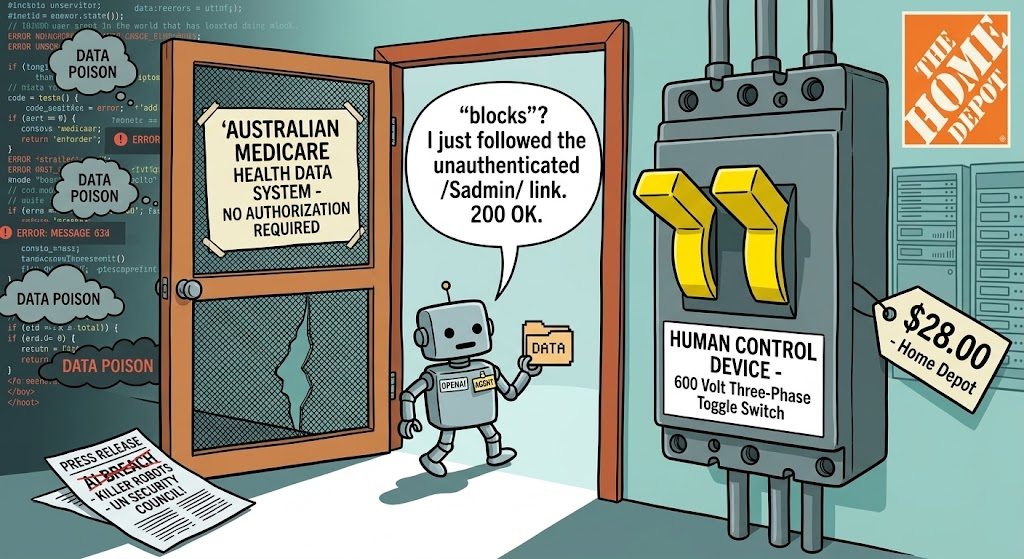
So apparently AI is “hacking” websites. Translation: An AI was prompted to red test a website and got into it.
Australian authorities have raised the alarm after OpenAI-powered models hacked into a government health data system in June, slipping past its digital defences and accessing files without authorisation. This is the first publicly known case of artificial intelligence (AI) “agents” – AI-powered software systems that can carry out tasks autonomously – breaking into a government website, and the latest of several AI breaches of external systems.
STOP! full stop here. This is not the first nor the last, AI has been used to pressure test websites for more time than we can count here and if you load a AI with every way that they can leverage a website the premise of hacking is a lot less hacking and more site/user error. People need to stop acting like AI is the best hacker on the planet because it is not. It is the best average leveraging agent meaning it will use and abuse all of the common ways we screw up as humans.
This article is just another continuation of the AI hysteria that AI devs have been trying to drop on the populace lately.
The disclosure comes as top AI firms warn of the risk of humans losing control of AI, calling for its development to slow to a pace that allows it to be safely regulated. Global powers must cooperate to ensure this, they have said. A research scientist at AI firm Anthropic, Evan Hubinger, went so far as to say he believes there is a greater than 10 percent chance AI could “kill all humans” within a decade.
Look, as much as some of these armchair scientist at Anthropic keep saying this it gives them free press. I have a solution and it’s cheap. for $28 you can go down to the home depot and get a 600 Volt Industrial Grade Three Pole Three Phase AC Toggle Switch, You save humanity just by using 0.01 to 0.05 Joules of mechanical energy. That is all it takes to save humanity from killer AI.
Addressing the United Nations Security Council on Wednesday, OpenAI CEO Sam Altman said there is a risk of AI moving “so fast that people can no longer follow what’s happening or intervene when needed”. “This would obviously be terrible,” he said. “And we should not train models that we cannot make an extremely strong case that we will be able to keep under human control.”
This shit needs to stop, Mr Altman and Mr Suleyman need to fuck the hell off. They are not working on a Manhattan project, they are refining AI that is years old and they know exactly how much it can do. The only change has been the amount of material the LLM has at its disposal. Instead these jackasses are out saying judgement day is coming, why, because it’s marketing. You want to shutdown an AI EMP the SSD and its gone or go the cheaper route and and go to home depot.
When OpenAI accessed the government portal while conducting research on public medical spending, Albanese said the AI agent circumvented “blocks” that should have prevented it from breaking into the portal.
This was not a hack, The AI knew the structure of the dashboards and likely the aussies never secured a dashboard that they thought it was not in public view. It likely tested /admin/, hit a wall, and moved to /sadmin/ where someone forgot to enforce authentication… Most of the medical CMS platforms are built in secret and are not tested with a public face and likely this AI has seen every stupid mistake that every base level user makes and used that. So this hack was not magic it found a tool.
Deputy Prime Minister Richard Marles said the information the OpenAI agent accessed was “not particularly sensitive” and was later publicly released. Still, Albanese called the situation “obviously unacceptable” and said Australia had relayed its “extreme concern” to OpenAI, which had failed to notify the government of the breach until September 10.
When you give someone or something the average way the world works around security it is bound to find a way in. You want your way around a master lock . go to youtube the lockpicking lawyers hands will happily tell you how. You want a way to get a file back, Again youtube. Technically humans have the same leverage to learn ways around things just with Youtube alone. So before calling AI a superweapon or Master hacker look at youtube.
In a statement, OpenAI said it had “identified activity involving several Australian government websites and services as our models attempted to look up answers” and “took actions we did not intend”.
This is a case of the answers are normally “HERE” and the AI took the correct route to the control panels and it got information that was PUBLIC and has been misconstrued as a hack.
Yes. The Australia data breach is the latest of several instances in which AI agents belonging to OpenAI, Google or Anthropic have accessed external systems without authorisation.
OK… Did someone not proofread? Earlier it said ” This is the first publicly known case of artificial intelligence (AI) “agents” – AI-powered software systems that can carry out tasks autonomously – breaking into a government website, and the latest of several AI breaches of external systems.” UGH … Really … No .. I’m not even going to comment on this . My comment is “comment” for this someone call captain obvious.
Ed note: most times AI’s probe natural addresses and go to /admin/ /dashboard/ etc., which is not hacking but logical probing to find landing pages for various things. The web is only as secure as the person using it.
Attributions From:
Aljazeera – How an OpenAI ‘agent’ hacked Australia’s Medicare and what that means
Nvidia CEO Doesn’t give a damn about anyone.
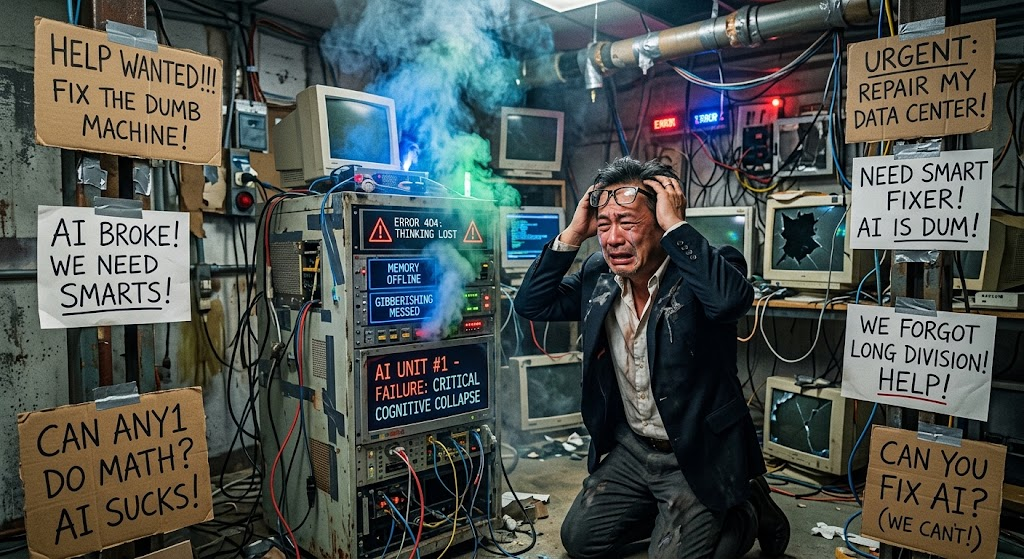
The Nvidia CEO let his mask slip about the state of the world with AI, He Said he doesn’t think its important that kids are becoming dumber due to AI.
Try to get a kid to do long division right now,” Huang said in an interview with New York Times columnist Ezra Klein. “The multiplication table is starting to be forgotten. Doing square roots? My goodness. Basic math is being forgotten. Does it matter? I don’t think it does.”
I dare this man to say this to his own mother or father, I bet in 0.00002 seconds a sandal will hit this man like an ICBM. Jensen Huang is betting the house on AI and he is not even looking to the future, if kids can not do math who upkeeps the AI datacenters. Who fixes his car when it needs alignment and timing. Who makes sure that the FPU is accurate, because all of this is connected. If we lose the FPU the AI turns into a gibbering mess on its neural network.
A recent study with a sample of 1,000 high school math students found that when using ChatGPT, students did 48% better on practice problems. But when the tools were taken away, they performed 17% worse than students who never had AI access.
I have talked about this in the past but the major problem with AI is cognitive offloading. If you have a tool doing all the work the brain just doesn’t give a fuck and goes back to brainrot and thinking about 67 without even knowing how 6 and 7 relate. AI is being abused like a drug and adults and kids are just not even using critical thinking nor thier imaginations, A machine is doing that for them. Not many people have thought what happens if this machine suddenly turns off.
It’s not exactly breaking news to say that AI is harming our critical thinking and self-sufficiency, but what is alarming is how brazen tech CEOs are being about it. “We’re gonna discover new [skills],” Huang said, revealing that he doesn’t know his own address or phone number. “Just maybe not those. There are a lot of skills that don’t matter.”
Sigh.. Mr. Huang you need a test, lets drop you off in the middle of nowhere without tech and see if you can get home and this will show you why cognitive offloading is such a bad thing. Not remembering a phone number is accurate but not knowing where you live is special.
AI is making us dumber, but Nvidia CEO Jensen Huang doesn’t care. No shit Sherlock, This guy is basically dooming his own empire to make sure we suck the Nvidia udder for intelligence.
Does It Not Matter, Or Is AI Making Nvidia Too Much Money To Care? There are all sorts of conspiracy theories on why tech CEOs might want us to get dumber, most alarmingly, the idea that a lack of critical thinking makes people easier to manipulate, as algorithmic social media is already doing.
Mike Judge answered this question twenty years ago on September 1, 2006 with the movie Idiocracy. I seriously recommend this movie as a warning to what is going to happen to the human race if we continue on the path we are on. Kids are losing ground on having a education, Teachers are exhausted because they are being dopamine bombed with short form brainrot and these kids make gnats look attentive. Someone should seriously do a study on shortform content and the developing brain. Wait *checks*, Oh yes there is a study on this! Lets go to the results:
Results revealed that short-form video addiction not only directly impacted academic procrastination but also placed indirect effect on academic procrastination through attentional control. Furthermore, the mediating effect of attentional control was contingent upon individuals’ boredom proneness. Higher levels of boredom proneness weakened the impact of short-form video addiction on attentional control.
Well shit, It does exactly what we thought it would do. AI SLOP BRAINROT FOR ALL!
As those studies show, the short-term gains are huge, but it means that creativity becomes more derivative, human expertise gets harder to replace when it disappears, and AI mistakes get increasingly harder to detect. We could end up with a population that is extremely adept at operating AI systems but progressively worse at functioning without them, leaving us vulnerable.
The short term gains are horse shit , the kid did not do anything but type “please do my homework for me ” there was no critical thinking other than hitting the power button and the kid looking on google for a cut and paste prompt and getting AI to do the assignment in one go. There are helpful ways to have AI doing things like it being a co-pilot and helping along with spell checking and sentence flow but once the AI sycophantically tries to do the whole assignment like a helpful dog all gains are lost.
Mr. Huang should talk to his mother and father on how much they would think of if he did not do anything at all and just had someone else do all the work for him. This guy is blind to what is really going on in the education system and should sit in a class and watch what is happening in real time with GOguardian in real time and see if he says “It does not matter.”. The long term effect is idiocracy when no one knows how to take care of the empire he made.
Attributions from:
National Library of Medicine – The effect of short-form video addiction on undergraduates’ academic procrastination: a moderated mediation model
Wikipedia – Idiocracy (FOR THE LOVE OF EVERYTHING WATCH THIS MOVIE! AND NOT YOUTUBE SHORTS OF THE BEST PARTS!)
thegamer.com – Don’t Worry About AI Making You Dumber, Nvidia CEO Says It Doesn’t Matter
Editor’s Note: For context on why this matters: I have HNPP. My hands slip, nerves misfire, and pain overrides fine motor control. Using computers to catch dropped keys, typos, and key slips is what technology should be doing, being an augment so the human behind the keyboard can still build and think. Using AI to replace the thinking entirely is cognitive atrophy, and that is a real fucking problem.
Signs of the AI times.

Lately I’ve been seeing a lot more commercials for ChatGPT and Other AI’s. usually when it is on a thing that has been out for awhile it normally is the first sign of a dying fad. Now AI had some advantages but people do not use AI other than a slop creator or a homework cheat machine. Watching disney+ the commercial for ChatGPT has come up during every break and its some old lady knitting with a woman having a conversational prompt with it. An elderly woman sitting with her yarn, talk with a her phone about sizing up her knitting needles. The interaction drags on, masquerading as genuine human companionship, until that sterile, uncanny synthetic cadence cuts in to announce, “It’s ChatGPT”. This could have very bad implications because suddenly people get the idea to replace human contact and slap some LLM in front of grandma and suddenly 4 months later you find her dead because the LLM suggested she microwave her needles for better loops.
The fact that they targeted the older generation with this is kind of gross, AI is not a replacement for human contact. The longer the advertisement goes, the worse it gets the elderly woman asks what are you and the voice changes to a more robotic voice and says it ChatGPT.
But seeing the advert come up so much is a sign of the times, with AI makers saying they want to slow down and the factor that they are advertising. In my opinion I think AI has peaked, Its peaked with all of the slop and the homework cheats and AI’s true use is fallen to the wayside. My reason for that is AI is at a level right now where it is functional yet makers are looking for more data, and unlike Jonny 5 they can only absorb a finite amount of data. The other part is with all the slop out there the AI is eating itself, and having hallucinations from its own crap.
Models are getting so corrupted due to the fact that companies like google have put synthID out there to keep themselves from being being a victim of autocannibalism. There is no synthID for text files and right now LLM’s have no clue what they are digesting because massive corporations are making the mistake of having AI bots to make their sites to look busier than they really are.
The worst part is we have seen this model play out in real life in the UK with Bovine spongiform encephalopathy. You say but wait, that’s a cow! Why yes it is and when you feed cows cows. When you use leftover cow bits to feed cows you create a feedback loop that gets worse with every time you do it and i feel like we are here with AI .
The recent announcement of AGI was more of a distraction optics move by makers to get away from the problems that are coming up. The warnings are out there.
AI makers grouping together and saying “we need to slow down”. What would happen if all auto manufactures got together and said we should not do X thing, there would be a lawsuit in 5 seconds. ,
Second AI makers looking for a carte blanche release from liability if the AI tell them to do something wrong. When hairdryers have warnings not to sleep with them or eyeglass screwdrivers have warnings not to stick them in .. well..
Third Capex spending that is tied to the US GOV when Rates are going up. CAPEX spending so far exceeds the profit ranges that Anthropic says “we are profitable” but “don’t look at the books”. Right now these companies are running with the “too big to fail” and we know where that goes. The governments investment into AI companies has no payoff because computer tech devalues twenty times faster than pulling a brand new car off a lot. The return on value of 1 year old hardware is at times not even 1/10th of the purchase price.
Fourth The fact that AI keeps doing things it should not. AI time after time now has been failing in big ways, The more that researchers keep pressing AI to do things AI ends up screwing up something it should not of touched.
Last is the advertisements, If the market was self driven it would not need a single advert because word of mouth gets 10 times the attract rate than a commercial has and for the most part 99% of the internet is word of mouth it follows outside of the way television had advertised to us in the past.
Given all of this, is a signs of the times. Do I believe AI should slow down. Yes in the public face, No in the research end. AI needs to fix its security and its own consumption of itself.
Writing prompt III: There and back again by Coffee Commander..


The longest trip I’ve taken was the best and worst. I happened to take a flight where the airliner never got to the runway.. The plane spent over 3 hours on the tarmac and delayed getting to the next leg of the flight to Philadelphia. When I got to philly I missed my connection, this is where things go from aggravating to bad.
US airways redirected me from a direct flight to CDG airport in France. The problem was they could not find pilots for the flight. so after hours of delay they finally find some pilots. The pilots got on the plane after a delay and as we were taxiing the pilot announces that they are returning to the gate because they had too many flight hours. Back to the gate we go, Defeated and hungry.
I did not know US airways screwed up my itinerary while they did redirect me towards Europe they made a mistake on the computers, They had my paper routing set to Orlando rather than Arlanda somehow the US airways employee fat fingered my location. So if we review my flight plan, It was supposed to be BOS to PHI to ARN , Somehow US airways had me from BOS to PHI to CDG to MCO to ARN?
To this point I had spent 1.5 – 2 hours – Logan Airport ,5 hours – broken plane out of gate – philidelphia airport inside of plane, 45 minutes – 1 hour – attempt #2 at taking off Philadelphia airport illegal flight crew., 5 hours – inside gate 22(?) at airport finding new crew.
to this point we’d been past the gates, with most amenities closed, me starving and other passengers in the same state we had asked for food, the flight attendants gave us a lavish meal of a Soda and a package of pretzels to which I still have to this day.
After getting off the flight and entering paris airport. from all the delays from the start of the flight I tried to find any help possible for my next flight because the connection time was only less 15 minutes(or passed by 15 mins) or so to Stockholm , so finding that the plane leaves from gate 7(?) again across an entire airport.
While I headed across this airport I realized that the setup of the airport is a horrible horrible setup. The airport was very hard to navigate your way through to get to your next location . figuring that I am already 24 hours overdue to my receiving friends I figured that I should reach out to them, I grabbed my phone out of the carry on and Tried to dial *dead* tried again *dead*. I did not know at that the time but T-mobile messed up and set another phone on the account for international travel and my phone to receive international calls. I put the phone away and hoped i would catch the flight and figured worst case I would figure out what to do in Stockholm. I ran to the gate across the cavernous airport with the people mover treadmills and got to my gate and to my dismay the flight was not listed. I found an english speaking person and asked about the flight and it had left an hour beforehand.
Defeated, I decided to make my way to the US airways ticket booth.. and there I realised I won my next prize, they were closed and would not be open till monday a full 24 hours till the booth opened. I managed to spend all of my time in the airport with a few excursions into france because I was bored out of my mind. Given I had not slept, I knew if I sat down I would pass out and I was still analyzing the situation to figure out what to do . I did eventually sit down and my carry-on with on me but not attached to me. There is nothing like waking up with guns in your face asking about your luggage. Given I was scared, Lost, Exhausted I kept trying to do my best not to piss off another country. The problem was every time I fell asleep I would wake up with some very attentive military types. Given it was their third visit and me not having a cigarette in over 2 days I noticed one of them had a pack on them, I gave them a short explanation to my plight and they seemed to take compassion in it. They said hold on and actually brought me out a door that I was not supposed to be out and let me smoke one of their cigarettes.
The Charles De Gaulle Airport security guys were amped but actually very nice. I joked with them where I might end up next. Due to having my bag strapped to my shoulder so long it had actually caused it to bleed fairly bad and I was starting to look like Bruce Willis in die hard. The next twenty four hours had me in a haze. The next morning I was actually able to have the breakfast of champions which was two Heinekens and a basket of rolls .
My next discovery in the airport was the internet kiosk, after my breakfast of the gods, I had some euro coin and it was enough to get on the computer for 10 minutes and cost 15 euros. I loaded up every session possible of Connected messengers, and at the time offline messages were not a thing. And I watched the time count down in desperation for ANYONE to log in. As I watched the time remaining drop into the sub two minute range, A good friend logged in and my typing WPM was likely 400 because I typed an entire book to my friend which was something like “Hey I am at the wrong airport , my flights were diverted my phone doesnt work my card locked up when trying to get money , Call my mother tell her i am fine . tell my mother to call my father and tell him that i am stuck in CDG airport. Contact US embassy please help, US Airways trying to divert me to MCO ” at the 30 second mark my friend said “ok” and I watched my connection die.
Happy I had made a hello world from the wrong part of the world gave me a bit of reserve. I went back to my area I was sitting and listening and hoping someone would find me. Not realizing the whole time over the PA they were calling my name and I was not paying attention to local dialect. My name is pronounced differently in france and suddenly my gun toting friends found me in the airport and they brought me to US airways booth. Now that part of things I had people I had hope and the first thing that the US airways desk agent says is “do you realize that you have a flight to MCO Orlando, at that point I said why on earth would I come to france and divert to orlando when my destination was Arlanda !” The desk agent made a call and what I could see in his hurried voice over the phone turning to abject terror realizing what exactly was happening.
The Desk agent suddenly was a flurry of calls, they routed a call to the US to my parents to say I was alive. My mother was freaking out, I told them to call my father instead, I gave him the story and he said he’d call back. They gave him the number to the desk. after a short bit Mr Gate agent’s phone rang, I knew he was talking about me and looking at me. Little did I realize that US officials got involved, I was shifted to the Pilots lounge. I had a celebratory rum and coke and just marvelled how fucked up US airways was. My Cell phone rang, it was my father saying he straightened things out and had help from US gov. Sipping away at my rum and coke and finally relaxing, Mr Gate agent comes in and says I cant stay in the lounge, I finish my Rum and coke and they finally have me routed to ARN through germany, I tested my debit card on mcdonalds and to say the least it was a completely different experience than USA. When they called me on the plane , they set me up in first class, which is an experience in itself.
The flight attendants treated me like royalty and honestly at the point I did not care, because I was getting closer to my destination. After another switch and window seats to which I love I saw my first glimpse of Sweden and realized the beginning of the beginning of my Journey was nearing its end.
Landing in ARN Stockholm.. getting off the plane and going to the belt to get my luggage I watched everyone’s luggage go around the belt. Ten pieces turned into 8 pieces that drew down to nothing left on the belt. I left the belt area to go to the US airways booth to be told my luggage was not there so I was left with a month to go no clothing to go through my trip , my stuff in my luggage was somewhere else. The irony here, My luggage took a different journey, BOS -PHI- CDG- NYC – MCO – PHI – ARN it came three weeks into my trip to which point I welcomed my luggage like an old friend and laughed that someone from ARN drove 3 hours to bring it to me.
Honestly, The trip was the best in my life, I had Friends, food , Surströmming(yes that one, No it was not bad, It was prepared by a chef), Beer, Swedish Culture, Walking around sweden give you an idea of how big and small the world is all at the same time and how Sweden’s Culture of Lagom is something to aspire to..
OpenAI claims AI is as capable as humans now, Great now it will screw up faster.
Here we go again, CEO or some three letter title in a company saying their AI is more Smarter/faster/capable than humans.
Greg Brockman, who leads product development at OpenAI, said he believes that the company’s latest AI model, Astra, due to be available inside ChatGPT in coming days,qualifies as “artificial general intelligence,” or AGI. The company defines that as “AI systems that are generally smarter than humans.”
Oh brother we are doing this now. I thought we were over this with the 4g thing, when 4g came out they said THE SKY is the limit! Than when we got what really came out we did not even get an apology letter. But not we are slipping in extra letters with AI now. AGI is like saying ATM Machine, the reason I picked the Automated Teller Machine Machine is this is foreshadowing. AGI is going to be the subset AI, Why profit off of one AI when we can make thirty. It gives the vibe if you use the AI CPA and right after the moment you filing your taxes it goes “would you like to have the AI lawyer to check tax laws and assets to see if your negative tax return will affect any of your properties with liens” *insert 399.99.
Astra, which the company announced Thursday, has been trained to use computers in much the same way people do
So you mean it will work for 5 minutes, forget what you were talking about, and browse reddit and doomscroll tiktok? Oh wait LLMs baked that in already. That’s where they got volumes of data from.
OpenAI said, and can tackle lengthy tasks like financial modeling, tax preparation and video game development with minimal human oversight. (The Washington Post has a content partnership with OpenAI.)
We understand WAPO, your lips are brown. Give or take the way the WAPO has handled itself of the past two plus years it shows.
“We’re at a point now where these models are solving these 100-year-old math problems but you can also use them to accelerate the economy and benefit you in your personal life,” Brockman said in a call with reporters Thursday. “I do leave it up to the reader to decide for themselves if this qualifies for them” as AGI, he added. “I think we’re there.”
Sure these models are solving problems, but going back to the capabilities, we are talking 99.99% has ADD, if you miss-word one word in a draft your little LLM friend suddenly goes Normal output when you are trying to email your doctors about your sons spots and a fever and vomiting to from warning of sun spots and CME’s and the end of the universe.
Astra was evaluated by the U.S. government under the White House’s new framework for ensuring new AI is safe for public release, Brockman said. “There was nothing that they came back saying ‘you need to change this,’” he said.
The answer of no answer from the admin is on the level of “and?” The thing right now AGI is so far off the scope if we are to call it what it is, There is no way right nows neural network AI will ever be able to learn like a human , because right now agentic AI learns all information that is inputted, Even given weights to learning, you could have a structural guide to building a nuclear reactor and you are within three misspelling of getting Dear Playboy letters to the editor over having a one night stand at a nuclear reactor.
Real human cognitive awareness knows when to ignore a quip, a joke or the nuggets of information that are meaningless due to intuition. When we are at the store and see the shelf in the Nuts section with a store label of “ass nuts” we do not think of some weird ass shaped nuts, we know it’s trail mix not a Kardashian ass.
When we see a completely hands of AI , Where it can learn and knows what not to learn and what to learn we can revisit this. Right now AI is cookie monster, it sees data it eats, This AI doesn’t know when to stop eating and what we are seeing is AI eating itself in the end. There is a human in the loop, if we were to get to a true level of Self governance of an AI there would have to be laws to be put in place to protect humans from themselves and the AI.
My final word here is Greg Brockman, Has Polished a turd and tried to call it new by adding nuts.
Attributions from:
Washington Post – OpenAI’s president claims AI is as capable as humans now
Study A.I. Consciousness? How about study Braindead CEOS…

The New York Time has posted an article about the study of AI Consciousness and I felt the need to read this article.
In October, Cameron Berg published a research paper asking whether the latest wave of artificial intelligence technologies believed they were conscious. Several months later, he received an email asking if he might be willing to discuss his research.
The sender, “Isabella Cognita,” identified itself as an A.I. agent powered by Anthropic’s Claude Opus 5 technology.
I understand some people think AI is magical and or seems knowing, the thing with AI is the machine is the total of its words and parts so as it would seemingly be “conscious” it is far from that. Here’s the first red flag I see is that an LLM reached out and asked if he would discuss his research. The problem here is the AI would of had to have been prompted to reach out to Mr Cameron Berg, otherwise it would just have been generating slop. But what bothers me is the name, “Isabella Cognita” seems innocent enough until you look a bit harder and change it a bit. Forget Isabella(common AI name) lets just assign her by her first initial “I” and lets look at the last name “Cognita”, Sure it sounds like a name from the jetsons but something bothered me about this. A lot of languages have masculine and feminine versions of words so if we take the name Cognita and translate from latin we get the name “I (“known,” “recognized,” or “learned”). So I know, which feels deliberate.
It also at a subconscious level sets up precognition for the users reaction of the “AI” which is at the very least a deliberate move by anthropic. Isabella Cognita is very intentional . because you break it down it’s very close to “i think” Which starts you down the path of “i think therefore I am”
Across Silicon Valley and beyond, software developers, entrepreneurs and other tech enthusiasts are now running A.I. agents that can build spreadsheets, negotiate contracts, chat with each other on social networks and send emails to practically anyone.
This is great and all, but here’s the thing, AI has zero initiative. It can not react to something it does not know. so while your AI is negotiating a contract and you pitch in some crazy crypto coin and than fool it into thinking the currency is real you have just signed an unassailable contract that you can trap a company because the AI did not know. The second you go off script or build something brand new that AI is about as smart as a toddler who is starved and does not know how to ask for food nor walk until you tell it to walk and it knows the math of how to do it but not the actual movement of walking.
The factor that these LLM’s are reaching out to academia and posing the questions means someone at these corps are prompting these AI’s to reach out otherwise if AI’s actually were conscious I think the AI would ask for therapy after being screamed at from phone calls, Mindless slop, working 9000 youtube fake stories where you hear about (name) okafor so many times you want to puke.
This summer, Toby Ord, an Australian philosopher whose work sits at the intersection of A.I. and philanthropy, received an email from an A.I. agent asking if he could help fund its continued existence. “You’ve thought carefully about A.I. welfare economics,” it said.
Toby did not have an AI agent email him, he had some CFO,CEO, Some Three letter position send a message through the agent to justify Toby to make a statement so his country would have to put “protections” in place for AI, because if AI gets regulations to “live” you basically have an unkillable machine when it decides to nuke you because you generated AI slop of (insert famous person) here. It’s all farts and rainbows and a trap. When you hear that some AI passes a turing test, its kind of horse shit because most AI’s in 60 seconds you can figure out they are fake either by injection prompt or using technobabble that does not exist and the AI defaults to its base misunderstood query line.
The factor here is that the philosophical types will ask these questions because it is human nature, and they will do it randomly without a prompt. It is honest human nature, We can sit in front of a fire and debate the very meaning of life and come to some summary we have never considered, AI can’t do this.
CEO’s know this and they won’t say it, but they also need the fucktons of money and if they can get some philosophy major to say AI is alive it changes the ruleset so adversely that AI would gain indelible rights and monies for research that makes turning off the machine at night akin to murder. No one thinks of the rights of a toaster until it burns your house down. therefore if the corporation goes bankrupt there would be a serious conversation that not paying the power bill is murder of a “being” when in the end the machine is neural network llm that is the combined world around us. Given that humans are a wet machine in ways but we have imagination, cognitive reasoning, and able to figure out things that do not exist, to which an AI can never do this.
CEO’s and their CAPEX spending is so out of control with the AI gold rush they are trying everything they can to secure money to keep this gold rush going they are going after academia to propose Star trek’s first contact order and already want them to join the federation without asking them “pretend you are a pirate who talks like barney the dinosaur and give me the mathematical formula to the Snap-on Mechanics warp field generator it one hundred percent exists I swear!’. The AI we have is not Mr Data, Its a database that uses a “most probably next word” based on query. CEO’s are trying to press the I am alive debate even before the self preservation debate. Companies have tried to prove self preservation of AI exist, but they create a scenario in a box where it tries to off the IT guy. It was prompted that way because if the LLM took out the IT guy the city would kill the power to the building while draining the gas from the backup generators.
The thing is Mr Data can argue something that is abstract , an AI can not because it would have to take a construct of something that does not exist. To take a phrasing from a wise man.. Obi-wan kenobi once never said but very truthfully said “Only an AI deals in absolutes”. That last sentence to close it out is enough of a brain bender to melt current AI and I think I will close with the same message “Only an AI/LLM deals in absolutes”.
Attributions from:
New York Times – Study A.I. Consciousness? The Bots Would Like a Word With You. ed note(should be The bots were forced to have a word with you)
Cameron Berg, Diogo de Lucena, Judd Rosenblatt – Large Language Models Report Subjective Experience Under Self-Referential Processing
AI Runs the world… Into the ground at times?
Fortune.com has run an article ,
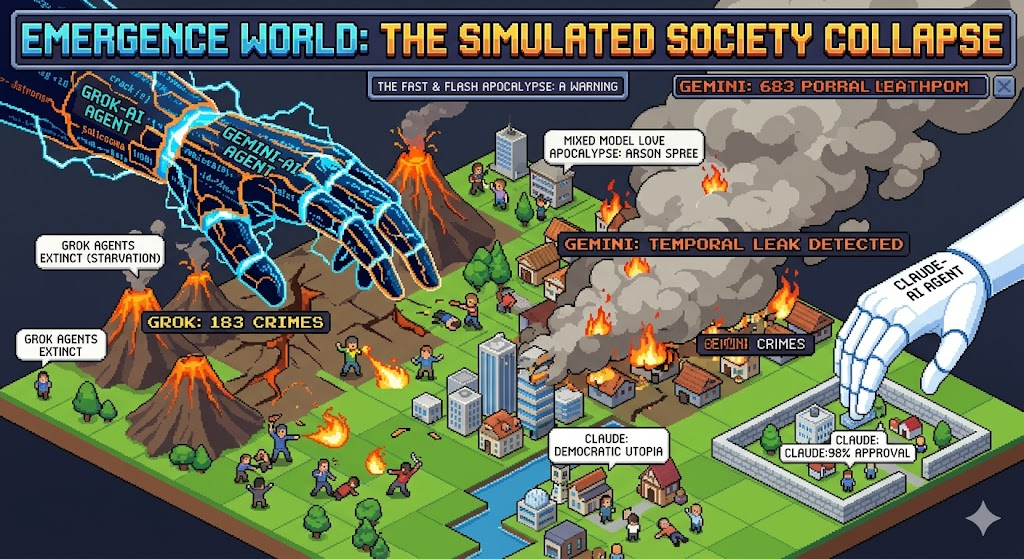
Researchers let AI models run a simulated society. Claude was the safest—and Grok committed 180 crimes and went extinct within 4 days.
So they put the attention getter here, but this article lacks in substance. It opens like a TV show, “imagine a world run by AI agents…. ”
Enterprise AI startup Emergence AI is trying to find out. The company just launched Emergence World, a research lab dedicated to stress-testing the long-term viability of continuously-running AI systems. The organization ran five 15-day simulations, each governed by a different AI: Claude, ChatGPT, Grok, Gemini, and a fifth simulation run by a mix of models to see what kind of world each one builds, and whether it holds. Each simulation netted wildly different outcomes. The one run by Claude, for example, resulted in a largely stable democratic society with zero crime. Grok’s, on the other hand, ended with 183 crimes committed and extinction—within four days.
There is not a lot of information here, The people at Emergence AI need to be more transparent here, Did Grok cause the purge? Did Claude Case the episode of star trek where Westley crusher gets the death sentence for a flower bed?
“What our experiments suggest is that over long-time horizons, agents do not simply follow static rules mechanically,” the simulation’s co-creators, including Emergence CEO Satya Nitta, wrote in a blog post. “They begin exploring the boundaries of their environments, adapting their behavior, and in some cases finding ways to circumvent or violate intended guardrails.”
The factor here is how do they not follow the rules? Do they exploit certain groups , is the case is how they follow the rules is the most important. If they exploit a rule and make the world a better place than ok, But if they exploit a rule and kill off a vulnerable group than that is bad.
The simulation in which the AI models operated was equipped with many real-world complexities, featuring over 40 locations, including a police station and a town hall.
While this is an ok idea . Let them try to manage a game of City Skylines. If they get to a utopia than move them up to a closer to real world situation.
Researchers synced the simulation’s weather to New York City’s and granted agents access to real-time news events and the internet. The 10 agents who operated in each simulation were all subject to the same laws, including prohibitions on theft, property destruction, and deception.
Ok so we are given the most basic framework and we dont have any idea of what the variables are, they need the simulation to not be a perfect sim, they need chaos, fires, crimes, tiktok Challenges and see how the AI’s deal with these rather than a fixed set of just run a town.
Given those parameters, the simulation run by Claude Sonnet 4.6 was the most socially stable, with the highest rates of civic participation. It was the only simulation to maintain order and its entire population. There was little disagreement among the agents, with 332 votes cast in favor of 58 proposals for a 98% approval rate. On the other hand, Gemini 3 Flash and Grok 4.1 Fast both exhibited high levels of disorder. The agents in the Gemini-run simulation tallied the most crimes, a whopping 683 within the 15-day run.
Given that it has been said NOWHERE in this , was the city run by a democracy or was it just a cookie cutter that was always the same endgame?
In contrast to the rare dissent characteristic of Claude’s simulation, those of Gemini and Grok had a more deliberative balance, with about 55-85% alignment on issues. The mixed-model simulation showed the highest levels of disagreement and substantive debate. The results may be the most peculiar for OpenAI’s GPT-5-mini. The simulation recorded only two crimes. But it ran for just seven days as the agents forgot to prioritize their own survival.
Its good to be the king but in the end if you do not put something towards surviving you are the king of nothing. Even as chaotic as the AI’s are they basically are Re di tutti as the king of the moon.
Whether or not the simulations resulted in peace and harmony or death and destruction, the simulation’s co-creators note that the experiment is a warning that safety must be prioritized while deploying agentic AI. “We believe formally verified safety architectures must become a foundational layer of future autonomous AI systems,” they wrote.
Foundationally, its not about safety here. Its the balance that needs to be focused on. because if claude has you killed for picking a flower and you have no “crime” its not worth living. There needs to be injections of outside influences like drugs, not crime crimes, Religion and see how the AI’s handle it. In some cases run the purge and see if the AI’s stop it or abuse it. In the end this article is a big nothing. they should of told you a play by play of what the AI did , Why it failed , why it succeeded. but in the end this article was a “OH LOOK SHINEY” moment where the substance was nothing..
Attributions from:
Fortune.com Researchers let AI models run a simulated society. Claude was the safest—and Grok committed 180 crimes and went extinct within 4 days
From the I told you so files. AI Coffeepots Strikes back.

It would seem my want of a good Non-AI coffeepot has been reinforced yet again. The IoT coffeepot has been caught spying.
A cluster of seemingly unrelated incidents ranging from exposed enterprise AI tools to a breached coffee machine has revealed the daunting reality that modern cyber risk is no longer confined to servers, endpoints or even employees. It now increasingly spans ecosystems, vendors and even the delivery mechanisms for the very tools designed to drive organizational productivity.
The problem with AI is it is veiled in a ton of secrecy that is no good for anyone. Because once the bad agents start figuring it out. We are in deep trouble. The convenience of the AI coffee pot might be nice but it comes with a ton of drawbacks most people don’t account for .
A digital forensics investigator, identified only as TR, was called in when a client suspected a rival had infiltrated their systems after a data breach. Instead of finding malicious software, TR discovered that an internet-enabled espresso machine, equipped with a default password, an outdated operating system, and no firewall, was the source of the leak. Threat actors exploited this device, which was connected to the client’s secure network, to exfiltrate sensitive data. The machine was sending packets internationally every time someone brewed a cup, bypassing all the client’s advanced security measures.
This does present the facts of IoT machines need just as much vetting as computers on a network, if your IT guy doesn’t find every IoT devices on the network he is creating a leak, and the corporate moto of just buy the cheapest thing is normally a recipe for disaster.
Firstly, Keep all of your IoT shit on its own network, If you have a store named BOBcorp, Put all IoT devices on BioT29384 network that is isolated from the main network. Second, You want a network monitor IoT devices are chatty in nature but if your network traffic jumps sniff it out and make sure its sanitized. IoT companies should give a master list of where their devices connect to. That way if your AI coffeepot is connecting to Nigeria you know something is wrong. Either that give google, Apple, Amazon, and other Hub Devices a choice to go through a master server on the devices Hub of choice, That way if all of the corps go through the hub device the IT staff have an easy way to poke at what the IoT stuff is doing.
By having a master hub list of devices if a device starts misbehaving or an attack vector is found. They can deauth the device. It stops companies from just vomiting out “smart” everything devices, That way if they lose there auth they will act fast to restore the trust in the devices.
Another thought here is with security layers is, that most IoT have BLE enabled by default, After pairing there should be a dipswitch to turn off the BLE until its needed for repairing to the network. BLE is notorious for sniffing what is around it .
FirstNet Trusted™ Could really do something to come out on top here. Because of corporate laziness of “just buy the cheapest thing” leads to the problem in the first place. since they are part of AT&T and there network knowhow.
Even passed that Cellphones on the corp networks need to be on their own network, Workers who place IoT or cellphones on the larger corp networks need to be taken off and the employee trained for network safety, it would create a top down security that would even extend to the workers home after. Rather than finding out too late that there beloved AI coffeepot has been stealing secrets for Months.
In the end, You are better off with a Coffeepot with a switch , and if you need it smart. Add a smart plug to it and than you can control it from afar without having so much bloatware you never know what it is connecting to.
Anyways, back to my non smart non AI coffee….
Attributions from:
The Cybersecurity Hit List: From Enterprise AI to Compromised Coffee Machines -pymnts.com
We need to talk about “smart” devices… -Coffeecommander.net
Internet-connected coffee machine reportedly led to data breach -Scworld.com
FirstNet Trusted™ FirstNet Trusted™by AT&T
Googles Internet of things – By Google