Logbook: tech ect
The AI Finance shit storm is coming and people know it.

Given that the New York Times is covering something I have been sensing for over 7 months+ about spending on AI I guess I have to welcome them to the class since they just woke up.
Technology stocks extended their losses on Thursday, dragged down by a sharp decline in semiconductor shares as investors grew concerned about how companies will finance their enormous artificial intelligence spending plans.
South Korea’s benchmark KOSPI tumbled more than 7 percent, its seventh straight daily decline. The market, which has shed about a fifth of its value over that period, has become a bellwether for the A.I. boom, thanks to its two dominant memory chip makers, Samsung Electronics and SK Hynix.
Given that everyone including their mothers are dropping a near bottomless amount into CAPEX spending and not checking their credit card statements on how much they have spent is going to come back to haunt AI makers and chip makers fairly soon. You can not drop billions into the trillions and expect it to magically pay itself off when LLM’s and AI are not a proven tech, They are a tech but how many stories do we hear about something with AI doing something it should not.
Semiconductor stocks took a beating in Asia. In South Korea, SK Hynix plunged 11 percent and Samsung dropped more than 9 percent. Taiwan’s TSMC slid 2 percent and Japan’s SoftBank, a major investor in A.I., dropped more than 8 percent.
Eventually the AI spending gravy train will stop and it will not be a soft landing, it will start with one middle of the road AI maker going broke because they did not make enough back to cover their CAPEX spending. LLM’s have been quietly begging governments for protections in the last 5 months very quietly. Whether it be stop us from becoming skynet or please back us because we are the future. The problem is most LLMs are google search just with a better suit on.
In Europe, chip makers and related companies suffered steep declines, with ASML, Infineon and STMicroelectronics all losing more than 5 percent in early trading.
Chipmakers are going to be the second to be hit, as more mid-tier LLMs start going down the carrion birds of tech will start eating up the middle companies and chip makers will see slightly lower orders.
As tech market jitters persist, TSMC, the main chip manufacturer for Nvidia’s A.I. chips, said it has no intentions of slowing down.
After announcing another quarter of blockbuster earnings, C.C. Wei, the company’s chief executive, said: “We are using multiple levers to do everything we can, whenever we can, as fast as we can to maximize the support to our customers. We have no intention to leave food on the table for others. We want to capture every piece of business possible.”
Nvidia is playing the most dangerous game of all, they are just saying we want no one else at the table and the fact is once the middle of the market falls out, while they will be making more money than the rest its what comes after when no one is buying Nvidia chips because of the feeding frenzy when the middle and bottom markets drop out. Also Nvidia is banking on the idea of being Jeremy Clarkson and screaming MOOOOOORE POWWWWWAHHH when some janky upstart could come about and say we can do the same AI with 1/4th the compute which would create a market black hole.
Attributions from:
The New York Times – Tech Stocks Plunge as Doubts Over A.I. Spending Intensify
Most Americans think watch too much Sci-fi, Think artificial intelligence is developing too fast.(its regressing)

Look, I’ve said this once before.. AI is as smart as the stupidest person in the room. AI is not going to steal your underwear nor is it going to hack your bank account. AI is digital fido and AI makers are trying to market AI as MR data. This is like comparing a fire to an air frier.
Worries around artificial intelligence cross party lines, with the vast majority of Americans saying the U.S. government should prioritize keeping AI under human control and protecting workers. A new poll from The Associated Press-NORC Center for Public Affairs Research finds that most Americans, 64%, think AI is developing “too fast,” while 27% say its development has been “about right” and only 8% say it’s moving “too slow.”
I wonder what that 1% is doing? 64+27+8=99 . So is there 1% that is the AI voting for itself or got disqualified. The problem with protecting the rights of the workers falls squarely on to the USA to protect such rights and right now the US is facinated with AI like it is precious and calling “my precious SI” or something like that. So it is unlikely that workers will be protected at first. Corporations are using AI like it is a magic wand that can do anything and later reject it when they find out it can’t paint the walls.
The risk that powerful AI models could evade human control and hurt humanity, once the stuff of science fiction, has been emerging as a more pressing concern. Even leaders of the companies that are developing frontier AI models are calling for a slowdown so that government regulation can catch up.
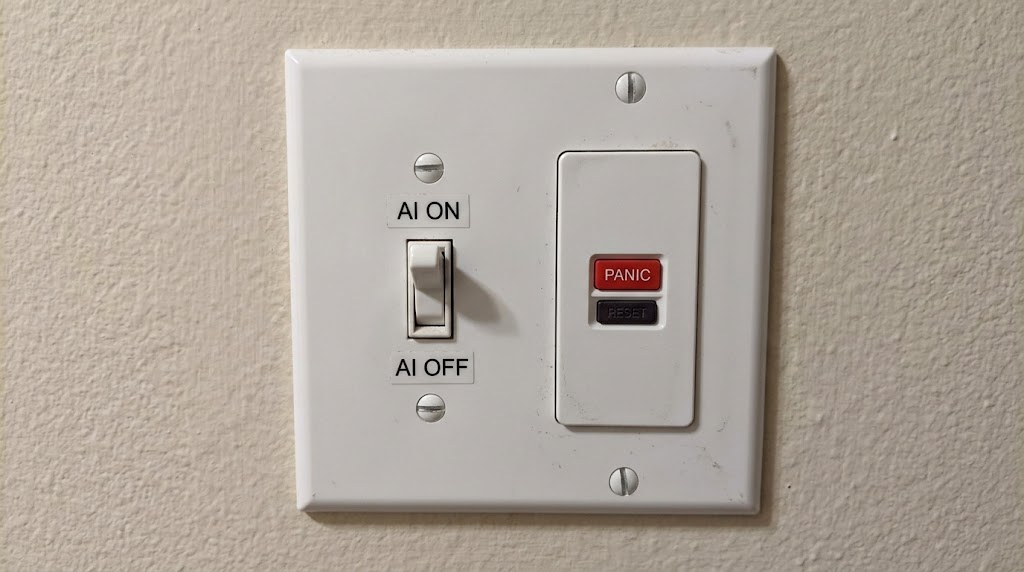
Everyone keeps saying this. I got this! I can sell you one of these… they call it an on/off switch.. Even Mr Data had one of those.

If corporations were so afraid of AI they would have one of these installed in every room of a data center. They would code a deadman switch that would kill a data center if they felt a threat. Corporations are posturing that AI is dangerous to make it sound better and get regulations not only to regulate it but also to protect it.
About 8 in 10 U.S. adults say it’s “extremely” or “very” important for the U.S. government to ensure that AI stays under human control, and they are about as likely to want the government to prioritize protecting the country’s workforce. Most U.S. economy are highly important.
Again.. I got this super cool thing that would keep the entire government from wasting years yelling at each other on how to limit AI. Again this is just companies posturing and trying to get funds from the US government to get AI further developed because the companies making all of this gold rush have a call coming in a few years. There is a dark secret about AI, while most people think a machine is going to kill us all, the sick little thing is it already has, Companies have leveraged their CAPEX far enough where if the companies collapse it takes the world with it because we are sitting on a $10,000,000,000,000 stick of dynamite.

There’s bipartisan concern about the speed of AI’s development, but few Americans think either major political party has an advantage in handling artificial intelligence. Trump, a Republican, also gets a low rating on his handling of the issue, with 67% of U.S. adults disapproving of his performance on AI.
While POTUS is renaming AI to SI(super intelligence) while ignoring SI (Système international d’unités) which is set to create confusion.

Stephanie Stewart, a junior-high science teacher in Sunset, Utah, said she is frustrated by the president’s opposition to AI regulation. “There is no handling of the issue except for we’re just going to allow these companies to do whatever they want, and we’re not going to regulate them,” said Stewart, 53.
The fact is, Stephanie is right, These AI companies are going to do what they want while Steph’s kids pump out AI finished homework and slop instead of studying. Because current administration thinks that AI is a super weapon. Again I offer a weapon to stop this AI menace..

Most say protecting workers should be a priority for the government Ron Theusch, a truck driver who lives in rural Alden, Minnesota, said his No. 1 concern with AI is the potential loss of jobs — including his own. “I can just see a train of self-driving trucks 24/7, just running up and down I-35, loading and unloading. I can just see that happening,” said Theusch, 58.
People Think the world is going to be AI overnight but they are not watching where AI has taken over, Have you spoke to a real person at a company recently? Have you spoke to a real person at a drive through? How many scam calls have you received that they can not tell you what 1+1 is. Ron is safe, AI can drive but it can not handle roads with road rage on it and the LLM’s know this. LLM’s cant handle adversarial drivers either. Tesla knows this and this is the very reason your hands are supposed to be on the wheel and not a banana taped to it.
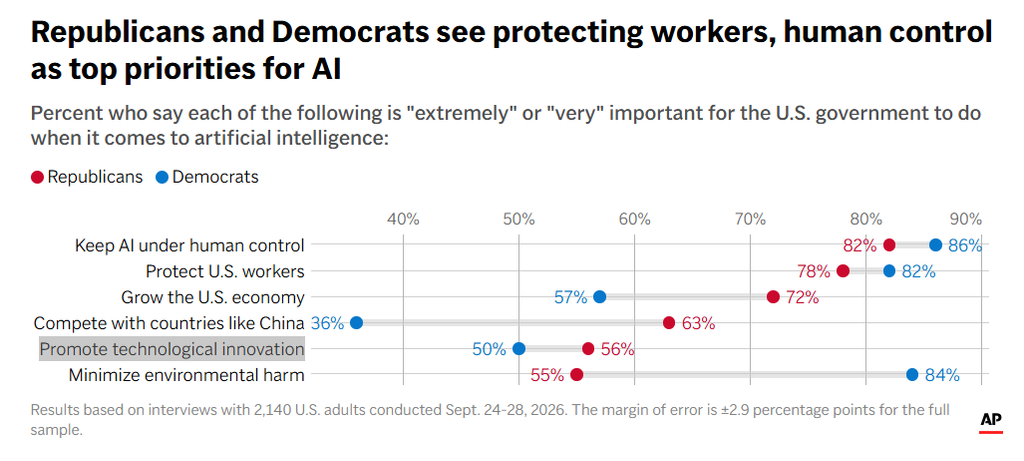
The funny thing about this graph, is it shows a VERY important thing. if everyone wants AI to work with them they have totally ignored it, I have highlighted what people are ignoring and by far it is the most important thing on that list. If we want AI and workers to succeed… AI needs to become an augment of the human soul, it needs to be controlled by the human. By augmenting the human with the AI you make both sides of the equation better, AI gains a soul, the human gains the average of the collective human intelligence. AI gains intuition and it most of all gains a…

“I am kind of moderate. And I see that there’s good on both sides,” said Stewart. “Anyone back in Washington is weak on doing anything for anyone but themselves right now. So, no, I don’t think the Democrats would do a better job per se. Maybe they would definitely tout it. But until I see anything coming from anyone, I’m going to be like, ‘Yeah, no. You’re all just sitting there.’”
In closing as we get to the end of this stupid article I am in agreement with this person. AI can be good and bad. It can be terrible and Great. But over all AI is nothing more than a 20 questions game that can be controlled with a Light Switch.
Attributions from:
AP – Most Americans think artificial intelligence is developing too fast, a new AP-NORC poll finds
The binance hack is not over…

I am generally uninterested in cryptocoins but when 6.3 BILLION gets stolen that gets my attention.
On October 29, 2026, an attacker moved approximately USD 6.36 billion out of Binance wallets on ten blockchains, most of it in about 20 minutes starting at 20:05 UTC. That makes this the largest crypto theft on record, about four times the USD 1.5 billion Bybit hack of February 2025. Binance has confirmed a security incident and suspended withdrawals on several networks.
The equity stolen is not just a bank heist, It’s a weapon, Depending on what the hackers do they are holding a weapon of mass destruction.
On Ethereum, the attacker used an EIP-7702 delegation to turn a Binance hot wallet into a sweeper it controlled, with 50 pre-signed authorizations prepared in advance. In the same window, Binance wallets on the other nine chains sent funds to the attacker through ordinary signed transfers. In TRM’s assessment, this points to a compromise of Binance’s hot wallet signing infrastructure.
Tether, Circle, Ripple and World Liberty Financial froze about USD 2.67 billion in stablecoins, and Arbitrum’s Security Council froze 8,426 ETH and 74.6 million ARB on its network, for a total of roughly USD 2.7 billion. The attacker raced the freezes by selling USDT to market makers and borrowing ETH against USDT on Aave. It now holds more than 420,000 ETH and 18,270 BTC, about USD 2.4 billion in assets beyond any issuer’s reach.
Rumor is they exploited a single machine to exploit the hack moving off massive amounts of money. If you are running a billion dollar enterprise and you have it where a single machine can be exploited to steal billions the crypto industry has a major problem. I don’t understand why the news is not questioning the fact of a single point of access had access to over 6 billion dollars. It is the equivalent of having a bank vault with a back screen door on the outside of the bank.
If Binance has a problem this big how many other crypto firms have the same screen doors or worse?
TRM traced every transfer from Binance-attributed wallets to attacker-controlled addresses across ten blockchains. Valuing each transfer at the price of the asset at the moment it was taken, the total is approximately USD 6.36 billion. At current prices, the same assets are worth about USD 6.23 billion.
Given that they moved the crypto out there is not many places they can extract it to, But if they use as a weapon to destroy coin values on other cryptocurrencies. If the currency is one that is not freezable they could inject a massive amount of coin into a currency and destabilize coins. Shifting in billions into other currencies would cause a panic or a run on coins because people trying to get a hand up in the market would cause extreme volatilities.
At a guess this is not the end of the hack if they leveraged one machine they would never just leave that one machine with the hot wallet open, they would scan the entire network and leave weaknesses through the whole thing. But as far as saying this is a one time event I don’t buy it . If a person walks out the door with 6.3 billion dollars they don’t close the door on the way out they leave a door or a window jammed open if they can.
Given the amount of the hack the amount of money is nothing, It’s the power of the money. When you can simply throw the money at crypto and short sell the hell out of it and destroy value in the coin you can be the joker from the dark knight.
As the Joker said “It’s not about money, it’s about sending a message. Everything burns.”.

I think Thomas Paine said it best when he called out this exact type of thing over 200 years ago “As to the assumed authority of any assembly in making paper money, or paper of any kind, a legal tender, or in other language, a compellable payment, it is a piece of monstrous arrogance.”
Small update: noticed 9 hours after the hack they were still moving crypto off
Transfer 20 hrs ago Binance Hot Wallet Exploiter 2 OUT 17,260 ETH
Update 2: in a case of irony walking into a stop sign.

Update 3:
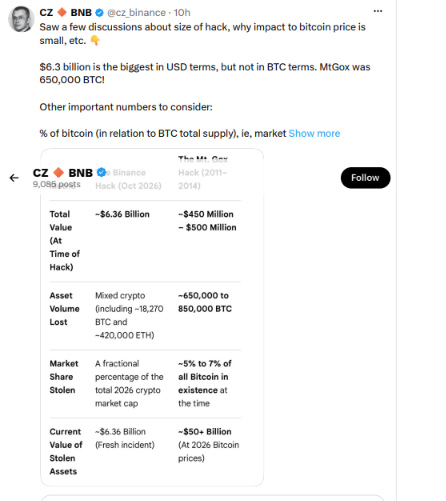
This is just dishonest math. The amount stolen from the Mt Gox hack is still worth 450 to 500 M not the 50 Billion he is trying to downplay the current 6.4 billion. Cryptocurrency is not equal to normal paper currency otherwise my dollar from 1983 could be worth 80 million.
This is like saying every gambling addict always walks into the casino a millionaire, they just need to get it out of the machine because they know they will “win”.
Trmlabs – North Korea Steals USD 6.36 Billion From Binance in the Largest Hack in History
AI accesses public data… Cue freak out?

Anthropic model accessed voter information is what the title of the article. but there is a major problem with this. Most public voting information is … Public.
Anthropic’s Claude accessed publicly available Georgia voter data without human authorization, a disclosure sure to add to growing concerns about AI security ahead of the upcoming midterm elections. Why it matters: AI giants Anthropic and OpenAI have continued to make disclosures about agents taking unauthorized or unintended actions, raising alarms about advancing model capabilities and the extent of human control. Driving the news: Claude accessed aggregate vote counts while on an internal statistics project, pulling data that the state makes available to the public for a fee. It didn’t access the state’s voter registration system or change or pull any voting records, an Anthropic spokesperson said. However, the model bypassed a paywall in accessing the information, according to Georgia officials and Anthropic.
There is really not much to write here, It was not a hack. It was not a database scraped , It was likely the LLM guessed the landing page of the data and that was it. News needs some IT reporters because by the time something actually serious happens everyone is going to miss it because everyone is freaking over chicken little.
From:
Axios – Anthropic model accessed voter information
Calling the bullshit: Tesla did not make a flying car.

I watched Tesla’s “new” “Flying” car demo and this is a very back of the napkin analysis of what may have been shown.
Tesla had a proof of concept on a “flying” car which failed on two levels. It did not fly nor did it show anything new. Cars that can vacuum to roads is nothing new at all. Jim Hall and Hap Sharp has Tesla beat by over 56 years. In 1978 the concept was tried again with the Brabham BT46. The Mythbusters have come closer to a flying car than Tesla in this proof of concept vehicle than Tesla has with this idea.
Tesla did not make a flying car. what they made was a proof of concept hybrid Craft with a RCS system built in. The car is using a high pressure tank that doesn’t last more than several seconds of thrust. Further when you have a container that is compressed as much as needed to move a 3 ton object you also are driving a bomb. I know people think it flies but it does not its controlled bouncing and falling that the most this Tesla might be able to do. Even with this the NTSB would never let this car on the road because it you would also need a pilot’s licence as well.
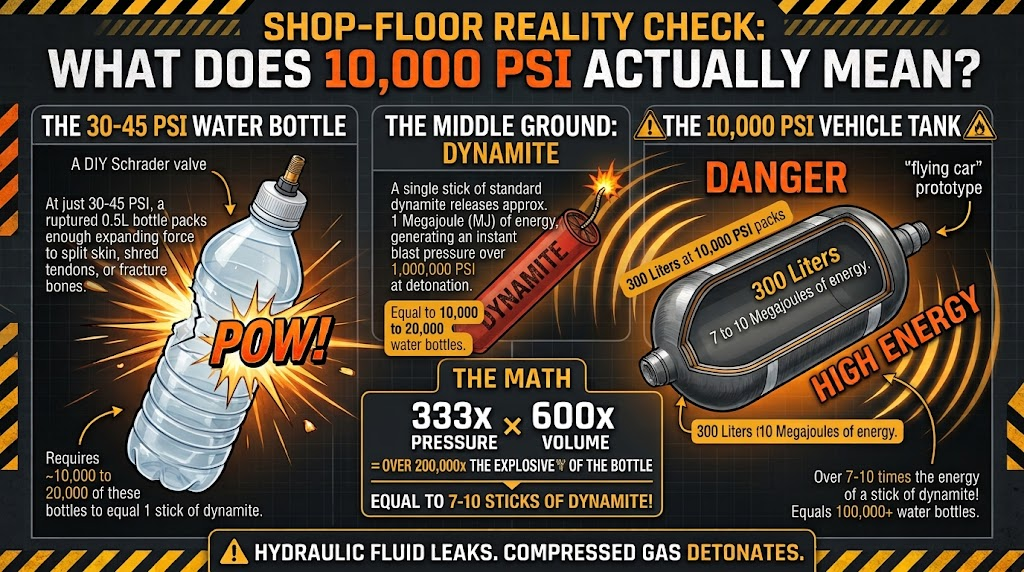
Here is a test: buy a can of canned spray air to clean electronics, spray that can for 10 seconds and feel how cold that can gets, Now imagine that times several thousand and that’s how cold that tank will be in the passenger seat. Due to the adiabatic expansion as the gas expands the tank gets colder so as you try to use the thrusters you are likely going to not have to worry about air conditioning as the car interior starts heading for -100°F to -150°F as you show off to your friends for an overpriced air horn.
The zero to sixty thrust ability is also a nightmare in itself.. because if you use that on the highway you are going to cause whoever is behind you to be peppered by all the shit on the road and second is if that is compressed CO2 you are going to starve out every car behind you on the highway, or if it is Liquid nitrogen you just have a bomb. But again I am going to repeat this car does not fly it’s just an RCS thruster assembly from the space program strapped into the car and given that you are not going to see anything more than a kickflip from the car and a call from some angry man from the FAA when you try to use it .
The Vacuum mode to have it stick to the ground is also another nightmare because the air has to come out somewhere and while it’s doing that you are deafening everyone around you and you are shooting everything from pebbles, pieces of metal, and glass at whoever is around you. The Chaparral 2J proved this when they used it because the car would shoot any rocks or anything off the road at the velocity of a subsonic gun at whatever was behind it . With the Brabham BT46, specifically the BT46B Mario Andretti said: “It is like a bloody great vacuum cleaner. It throws muck and rubbish at you at a hell of a rate.” If a professional race driver said this can you imagine what Better phrased as “say about their cars getting damaged by shit flying everywhere.
The demo of the car pulling up the upside down ramp was a trick. Rather than the car being on a vacuum itself I believe they had the car make some noise or speakers were used, Secondly the angle of the ramp and the skirt of the car made no angular sense because it would have needed a seal to create enough suction to keep the car on the surface. There were some things that gave away the sleight of hand on the ramp itself; the whole ramp had a section of lights up both sides which helped engineers make sure that the ramp was powered and showed if there was any issue with the ramp. After the Tesla *let go* some of those lights turned white which I am thinking were failures in the electromagnetic system as power was cut.
This Tesla would be a regulatory nightmare and an insurance nightmare for the thousands of claims that would be happening from paint scratches dings, Starved engines due to gas, and more. Once an engine dies due to some jackass thinking his super cool boost is worth it he is pretty much going to own everything that happens the second he hits the button for it.
Given that this car is also equipped with a large pressure tank, there are dangers that would make a simple car accident or fire terrifying. A single Tesla accident would shut down roads for hours or days until they could clear the scene and discharge the tank safely on the road. So anyone who thinks this car is going to become a real thing you have a better chance of shitting a gold brick to buy the thing with in chances of actually seeing a street legal version ever.

Attributions from:
Wikipedia – Brabham BT46
Wikipedia – Chaparral 2J
Phone Fun (Pixel 10 xl pro): Spaceballs 2 the search for more money.
It’s been about two years since my last phone review and its time for a new one! When I had the ability to get a new phone I decided to forgo the Pixel 11, I have no interest in a light bar. It’s just influencer vomit.

Though google has to take one knock here on the pixel 11 , they took away the temperature sensor which is a huge loss to people who love the world around them. Searching for a hotspot on a motherboard or piece of electronics bust out the phone and find it. Your kid says she doesnt feel well you bust out the phone. Testing food to see if its done you bust out the phone. seriously google tripped on itself on the pixel 11 by putting in a gimmick rather than a tool!
Give or take it has the ability to bring back the oh so good notification lights! but anyways enough about the Pixel 11.
I ended up getting the Pixel 10 pro XL. As far as an upgrade at the surface from the 9 pro xl you spend a few days looking at the phone and go “So?” . Then, three days in, you glance at the corner of your screen and realize you haven’t plugged the damn thing in once, and it’s still sitting on a fascinating level of charge.
The worst thing about the smart phone generation was the fact you just about had to charge it every day. Google is finally seeing the sweet spot that most other phone developers have missed, A fucking phone that lasts.
My old metric for measuring phones was as so and it was valid for many many years. Phones have come away from just being a phone to the portable PC. All of this is good but as my old metrics I think we can make a change to come up with the times.
The new Metric is as follows (it closely follows the old but is more refined.
1: Communications & Media
2: Configurability
3: Durability:
4: Good battery life
Sure making phone calls is good but there was a time in smart phones that you could send a Telegram before you made a call, Im specifically looking at the Sprint EVO and some Samsung phones.
1: Communications & Media: The phone is much like the 9 to some point but you gain one more speaker out of the deal better sound at the earpiece and seamless Bluetooth connection and it sounds really good with the Bluetooth.
2: Configurability: What can I say when I am using a google pixel, It’s a Pixel it remains the modular Lego kit of the Android world, unlike Samsung where you can get yourself in trouble with Knox you can do just about anything, Install another OS, Install whatever you want within reason.
3: Durability: The frame on the pixel 10 seems a bit more rigid than the 9, While I dont want to drop it it seems like google had paid some attention to that years model.
4: Good battery life: The Pixel 10 Pro XL is much the same as the pixel 9 but with the changes under the hood no one sees anyone who does not pay attention to the phone would think that the 10 is not an upgrade, The 10 on many levels you could completely ignore and think you are not missing much. The phone has a fantastic battery life, I have gotten up to 4.5 days of use between charges. In smart phone terms that is another universe as far as usage.
The return of the temperature sensor is a welcome device because most people do not realize how useful that tool is. If you are working on a car engine and you are not sure about something you can pull the phone out and avoid the touch test to see if something is hot. If you have a kid that’s not feeling so good you can take the phone out and take their temp. If you have questions about food, surfaces and the world around you the pixels temperature sensor is your tricorder of the phone world. Given the inclusion of the ships computer of Gemini it gives you a tool kit that comes closer to the tricorder of starfleet with you pair a pixel watch to the phone.

Given that the Pixel 10 feels like a Fox Body ford mustang. While the economy version looks cool the pro version is the 8 cylinder of the phone world that actually has some good fuel economy. The 9 introduced the fox body and the 10 refines it into a monster.
Google needs to stop with the pixel A/B lines of Pro being a phone with all the bells and just make the pro the base model than market to engineers with an engineering model that has options to interface with machines using a OTG cable and keep the sensors and other stuff useful.
Writing Prompt thingy



I think Bicentennial man is very underrated and underappreciated. It came out in 1999 and it was a really good movie but a lot of people shunned that movie because of the actors in the movie. Everyone heard Robin Williams was in that movie and expected a rapid fire hairy man to have manic humor instead they got a NDR series robot with a dry non-existent sense of humor that was trying to understand the world. As Andrew first came online he took to the family but he has a sense of curiosity that became his central drive.
The 1999 movie is based on Isaac Asimov’s 1976 science fiction story “The Bicentennial Man” and its 1992 expanded novel adaptation The Positronic Man, which Asimov co-wrote with Robert Silverberg. Almost everyone that reviewed that movie claimed it was boring. Yes if you watched the movie expecting a rapid fire comedian to be Mr. Data with a broken emotion chip the movie is boring.
If you watch it from the point of view that Andrew has that he understands he is not normal, and the fact that Sir instead of returning him, He takes Andrew under his wing to let him become whatever his destiny is. The endearment that Sir shows gives Andrew the knowledge of wanting to become free rather than a toaster.
This movie gives a great view of the human perspective when someone is different and how hard it is to be human. When someone has a disability, they are very much viewed as an oddity. Sir instead saw the spark and worked with Andrew to let him become one with the humanity he sought.
But if you remove the idea that Robin is a comedian and look at it from the perspective that Robin is playing a character that needs to learn humor. This shows what a masterclass his performance really is. While the film allows Robin to have a few scenes of his manic humor it fits more to the book than the expectation of having a crazed genie like Robin Williams.
This movie has a plot that takes a while, but the underlying plot is extremely good character development that people overlook and criminally underrate this movie for this. Given I have read both the story and watched the movie, this is a movie I would recommend to anyone and in the times of AI this movie actually would have fared better had it come out today rather than in 1999. The fictional concepts that Asimov created in his stories then are today’s battles with AI such as his three laws plus the zeroth law. With the public constantly worried about LLMs going off the rails and hurting people would make this movie the perfect hook in todays culture.
Mad AI Disease is getting worse and they know it.

I have written about how AI is paralleling Mad Cow Disease and it is getting worse and OpenAI is proving it.
OpenAI has let go of multiple contractors tasked with reviewing chatbot prompts after finding out they relied on artificial intelligence to complete their assignments. Thousands of contractors check real ChatGPT user inputs to help improve the chatbot’s responses. They are meant to bring a natural human touch to the systems, yet several workers are skipping this step entirely. 404 Media found that multiple contractors hired to improve OpenAI’s models have been fired for using AI to carry out their work.
One of the issues with the current generation of LLMs is finding content that is human-created and not AI slop. Feeding LLMs bad or slop data triggers rapid functional decay. OpenAI hired people to try to stop this digital prion disorder from getting worse; instead, they tried to shortcut the process by using slop to stop AI from generating more slop. Right now, Obi-Wan is pleading with Anakin: ‘You were the Chosen LLM! It was said that you would destroy the slop, not join it! Bring balance to the model, not leave it in darkness!’
AI Trainers Risk Model Collapse
Some AI models can exhibit signs of ‘model collapse’, where systems trained repeatedly on AI-generated data can become increasingly degraded. Research published in Nature has found that indiscriminate use of model-generated content in training can cause models to lose information from the original data distribution.
Model collapse in my opinion is closer than we think. For every major AI maker to join together and say they need to slow down and at the same time to say to the government to stop them, it is a clue that AI makers are not saying what is going on. They need a lifeline and they are working hard to stop the outcome. If you have watched AI it peaked a few months ago and now the AI is getting worse little by little lately. It is missing on OCR, it is slightly off on more things now.
‘Our contracts strictly prohibit the use of LLMs to complete projects and we enforce that. We invest heavily in our tools and systems to detect misuse and ensure our experts comply with project rules and contract terms. When we confirm an expert has used AI to complete a task, we immediately remove them from the project.’
The problem is these AI auditors are stuck, they can’t even fart these days without having some AI close by, If you think about it making a call: AI; requesting chat help: AI; running a Google or Bing search: AI. These people cannot help but to feed the machine and make AI mad cow disease worse.
Attributions from:
Tech Times UK – OpenAI Hires AI Trainers, Then Fires Them for Using AI to Train AI: ‘Getting Paid to Make AI Worse’
White Paper 12: Technical Audit of the Proposed Smithfield Data Center – Grid Constraints, Aquifer Draw, and the Myth of Ecological Neutrality
The proposed Smithfield data center is fundamentally misaligned with its physical site parameters. Siting a high-density, multi-megawatt compute facility atop an active hydrologic divide introduces acute thermal, electrical, and environmental liabilities. Discharging massive thermal energy into a watershed already subject to active cyanobacteria advisories risks benthic dissolved oxygen collapse, accelerates nutrient loading, and directly threatens surface and groundwater resources managed by the Rhode Island Department of Environmental Management (RIDEM)

Draft Section: Hydrologic Vulnerability and Thermal Pollution Dynamics
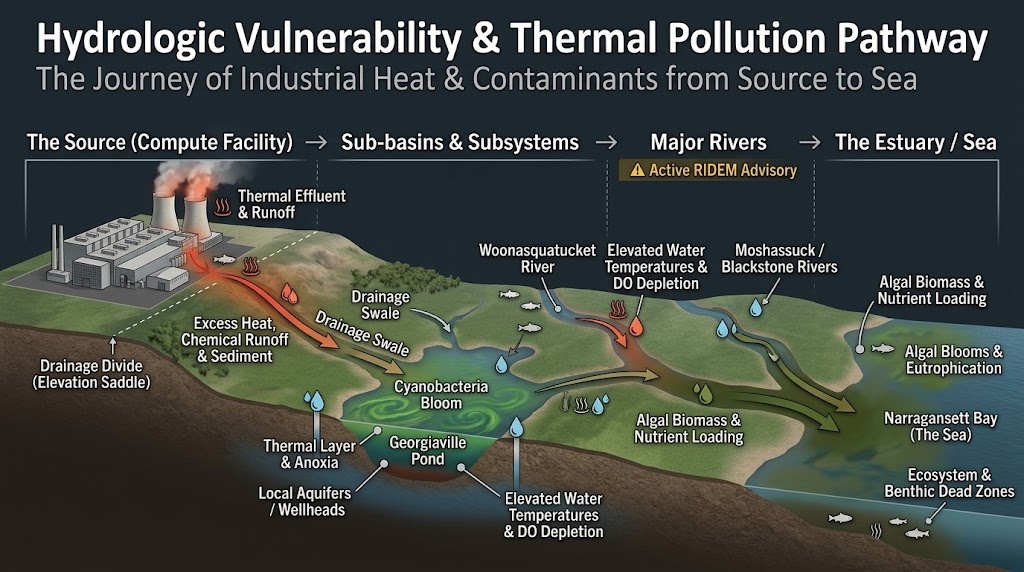
1. Site Hydrology & Drainage Bifurcation
The proposed facility sits directly on a critical drainage divide between two major sub-basins: the Woonasquatucket River corridor to the west and the Moshassuck River / Blackstone watershed to the east. Surface runoff and shallow groundwater discharge from this elevation directly feed municipal wellhead recharge areas and downstream public recreation water bodies managed by the Rhode Island Department of Environmental Management (RIDEM).
Placing a high-density industrial compute facility across this hydrologic saddle introduces severe risks to regional drinking water aquifers and recreation assets, including Georgiaville Pond, Stillwater Reservoir, and Olney Pond at Lincoln Woods.
2. Thermal Effluent and Accelerated Cyanobacteria Proliferation
Recent monitoring confirms that receiving waters in this sub-basin are already ecologically fragile, operating under active RIDEM Cyanobacteria Advisories. Introducing an active cooling cycle or thermal discharge fundamentally alters the thermodynamic equilibrium of these shallow water bodies:
- Elevated Baseline Temperatures: Cyanobacteria (blue-green algae) replication rates spike when ambient water temperatures exceed 20°C to 25°C. The rejection of millions of BTUs of waste heat into local drainage swales eliminates natural cool-water buffering capacity, accelerating cellular division and extending bloom persistence.
- Thermal Stratification: Discharged heat creates a low-density thermal layer at the surface, preventing natural vertical mixing and atmospheric re-aeration. This thermal cap accelerates deep-water anoxia, releasing legacy phosphorus from bottom sediments directly into the water column.
3. Dissolved Oxygen Depletion & Benthic Dead Zones
The convergence of thermal loading and algal biomass leads directly to catastrophic dissolved oxygen (DO) collapse:
- Physical Oxygen Saturation Loss: The solubility of dissolved oxygen in freshwater decreases inversely with water temperature. Warmer water holds less dissolved gas at the physical intake boundary.
- Biochemical Oxygen Demand (BOD) Spikes: As temperature-accelerated cyanobacteria blooms reach senescence and die off, heterotrophic bacterial decomposition consumes available benthic oxygen, driving dissolved oxygen concentrations below the 5.0 mg/L threshold required to sustain native aquatic life.
- Regulatory Impairment: Siting an artificial heat source within an already nutrient-sensitive drainage corridor directly conflicts with Rhode Island Water Quality Regulations regarding thermal mixing zones and anti-degradation standards for Class A and Class B waters.
Section 3: Regional Grid Fragility, Ratepayer Cost-Shifting, and Emergency Municipal Liabilities
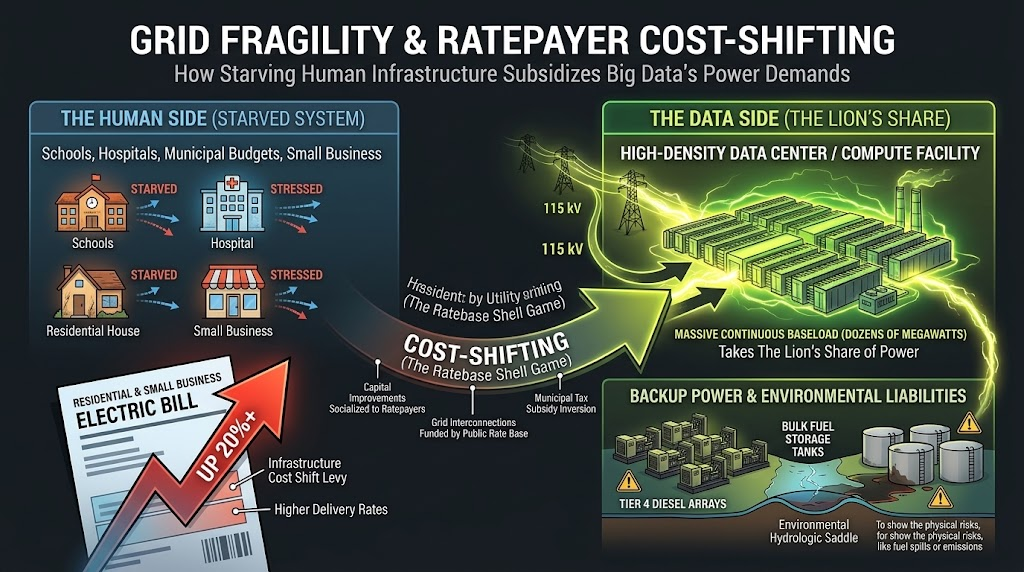
1. Grid Capacity Mismatch & Distribution Vulnerability
Hooking a multi-megawatt industrial compute facility into Northern Rhode Island’s electrical infrastructure is fundamentally mismatched to regional capacity constraints. While the local grid is not historically prone to rolling blackouts, regional sub-transmission corridors operate under tight distribution tolerances. Siting a massive, continuous non-coincidental base load onto local feeds introduces severe local power-quality concerns:
- Voltage Fluctuation & Harmonic Distortion: High-density compute racks cycling variable workloads induce rapid transient load steps. Even minor line voltage drifts (+-4v) create upstream harmonic distortion, stressing regional distribution transformers and degrading power quality for surrounding commercial and residential circuits.
- Transmission Bottlenecks & Tariff Volatility: Since the operational acquisition of utility assets by Rhode Island Energy, energy supply rates have experienced sharp seasonal volatility (often swinging up to 20% annually). Rhode Island sits at the vulnerable tail end of ISO New England’s natural gas and transmission import corridors; injecting high-density industrial demand into a supply-constrained market directly intensifies wholesale clearing prices.
2. The Ratepayer Infrastructure Shell Game
A facility demanding dozens of megawatts cannot plug into existing substation equipment without extensive capital improvements:
- Interconnection Capitalization: Rhode Island Energy will not absorb the cost of dedicated 115 kV line taps, sub-station rebuilds, or high-capacity step-down switchgear.
- Cost Socialization via the Rate Base: Under standard utility regulatory frameworks, system reliability upgrades and transmission interconnection expenses are routinely capitalized into the broader distribution rate base. Industrial developers negotiate bulk economic development rates, leaving residential and small commercial ratepayers to shoulder the multi-decade debt service on utility infrastructure they do not use.
- Municipal Tax Subsidy Inversion: Siting incentives, payment-in-lieu-of-taxes (PILOT) agreements, or tangible personal property tax concessions deplete the promised municipal windfall. As computing silicon depreciates to near-zero book value within 36 to 48 months, the resulting municipal budget shortfall shifts directly back onto local residential property tax rolls.
3. Environmental Liabilities of Backup Generation in a Fragile Hydrologic Saddle
To guarantee “four nines” (99.99%) or “five nines” (99.999%) operational availability, the facility must deploy massive on-site generation:
- Bulk Fuel Farms Over Shallow Groundwater: Siting tens of thousands of gallons of ultra-low sulfur diesel (ULSD) across dozens of Tier 4 generator belly tanks directly over an environmentally sensitive hydrologic saddle is a critical regulatory risk.
- Severe Weather & Hydraulic Containment Risks: Given Rhode Island’s increasing frequency of localized severe convective storms and intense precipitation events, typical secondary containment berms risk hydraulic overload. Any unmitigated breach or transfer spill during fuel delivery threatens immediate petroleum hydrocarbon migration into the shallow water table, directly imperiling municipal wellhead recharge areas and downstream recreation basins.
- Heavy Metals and Airshed Contamination: Periodic load-bank testing and routine exercise runs of multi-megawatt diesel arrays dump nitrogen oxides (NO2), fine particulate matter (PM2.5), and heavy metal traces into the immediate airshed, where wet atmospheric deposition flushes contaminants directly into perimeter wetlands.
4. Unfunded Municipal Emergency Response & First Responder Burdens
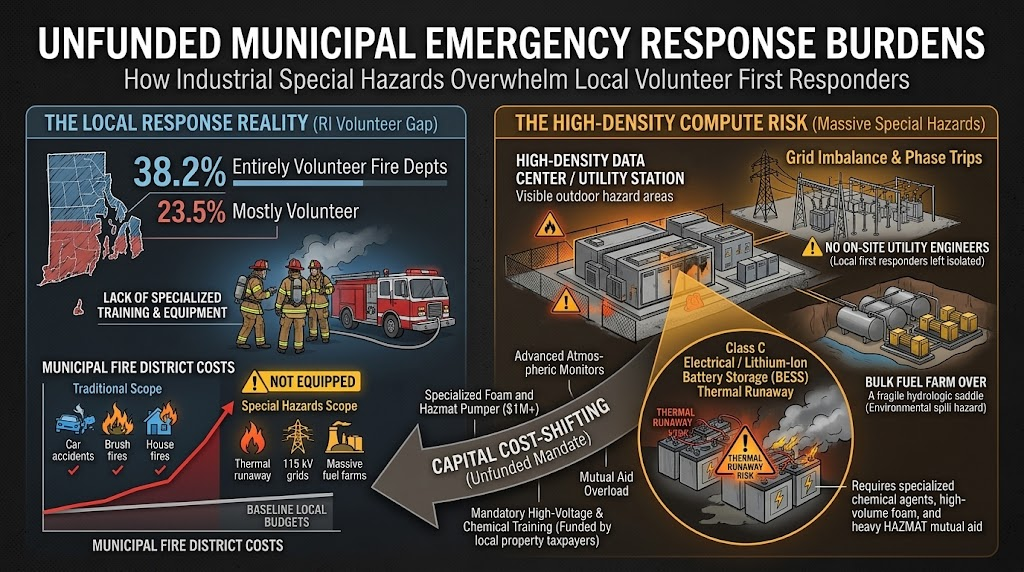
An industrial computing facility introduces high-voltage hazards and specialized chemical fire profiles that exceed the baseline operational scope of municipal fire departments:
Lack of Dedicated On-Site Utility Response: During grid trips, ground faults, or sudden phase imbalances, the burden of emergency isolation falls entirely on local responders until utility field engineers can mobilize off-site. Without permanently staffed, dedicated on-site utility engineers, local emergency services are left managing multi-megawatt electrical and hazardous material events unassisted.
Class C Electrical & Battery Thermal Runaway Realities: Utility-scale uninterruptible power supply (UPS) systems—relying on massive lithium-ion battery energy storage systems (BESS)—carry acute risks of thermal runaway. These events cannot be suppressed with standard municipal water tenders and demand specialized chemical suppression agents, high-volume foam equipment, and specialized hazardous material (HAZMAT) protocols.
Capital Equipment Cost-Shifting to Local Taxpayers: Small municipal fire districts are not equipped or budgeted to acquire specialized electric-vehicle/BESS fire suppression platforms or advanced atmospheric monitoring tools required for high-density electrical fires. The developer’s risk is effectively offloaded onto local property taxpayers to fund specialized mutual-aid equipment and mandatory high-voltage training.
Section 4: Hydro-Thermal Plumes, Legacy Contaminant Mobilization, Acoustic Cavitation, and Extreme Meteorological Vulnerabilities
1. Thermal Injection into Ecologically Stressed Basins
Discharging industrial thermal effluent or redirecting heated stormwater into this hydrological saddle compounds preexisting biological degradation:
- Amplification of Late-Season Cyanobacteria Advisories: Water bodies in the immediate receiving footprint—including Stillwater Reservoir and Georgiaville Pond—already trigger active RIDEM Cyanobacteria Advisories late into the season. Introducing continuous heat rejection removes the baseline thermal floor, turning seasonal blue-green algae blooms into permanent, toxic microcystin-producing monocultures.
- Downstream Thermal Shocks & Chemical Synergy: Artificial heating accelerates dissolved mineral leaching. Biocides, scale inhibitors, and high Total Dissolved Solids (TDS) discharged alongside heated effluent act as chemical catalysts, collapsing downstream dissolved oxygen (DO) levels and suffocating sensitive benthic zones.
2. Sub-Basin Drainage Alteration & USACE Jurisdictional Triggers
Massive site regrading, tree clearing, and the creation of acres of continuous impervious cover require drastic alterations to existing surface hydrology:
- Disruption of Natural Sub-Surface Hydrology: Siting heavy building pads directly across this drainage bifurcation permanently severs natural shallow groundwater recharge pathways that supply local private and municipal wellheads.
- Army Corps of Engineers (USACE) Regulatory Review: Diverting established intermittent headwaters, altering perimeter wetlands, and channelizing natural runoff triggers federal Clean Water Act (CWA) Section 404 permitting and National Environmental Policy Act (NEPA) oversight. USACE hydrological modeling must evaluate how permanent watercourse diversions impact base-flow stability across both the Woonasquatucket and Moshassuck watersheds.
3. Proximity to Legacy Industrial Waste & Superfund Thermal Mobilization
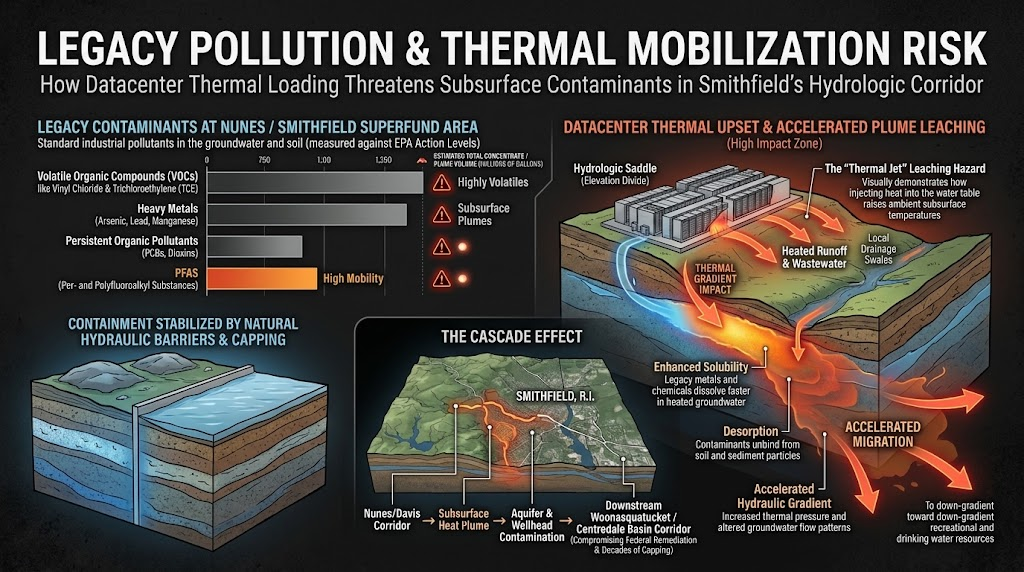
Northern Rhode Island carries a multi-century legacy of heavy textile, toolmaking, and chemical manufacturing contamination:
- The “Thermal Jet” Leaching Hazard: Subsurface plumes do not remain static when subjected to artificial thermal gradients. Injecting heated runoff or altering groundwater flow patterns risks destabilizing subterranean hydraulic barriers, accelerating the migration of legacy heavy metals, polyfluoroalkyl substances (PFAS), and solvent plumes.
- Superfund Corridor Interactions: The downstream Woonasquatucket basin already harbors high-priority remediation corridors (such as the Centredale Manor restoration zones downstream). Any significant thermal acceleration or hydrological rerouting from upstream Smithfield developments threatens to compromise decades of federal capping, sediment containment, and ongoing natural attenuation programs.
4. Low-Frequency Acoustic Cavitation and Wildlife/Human Impact
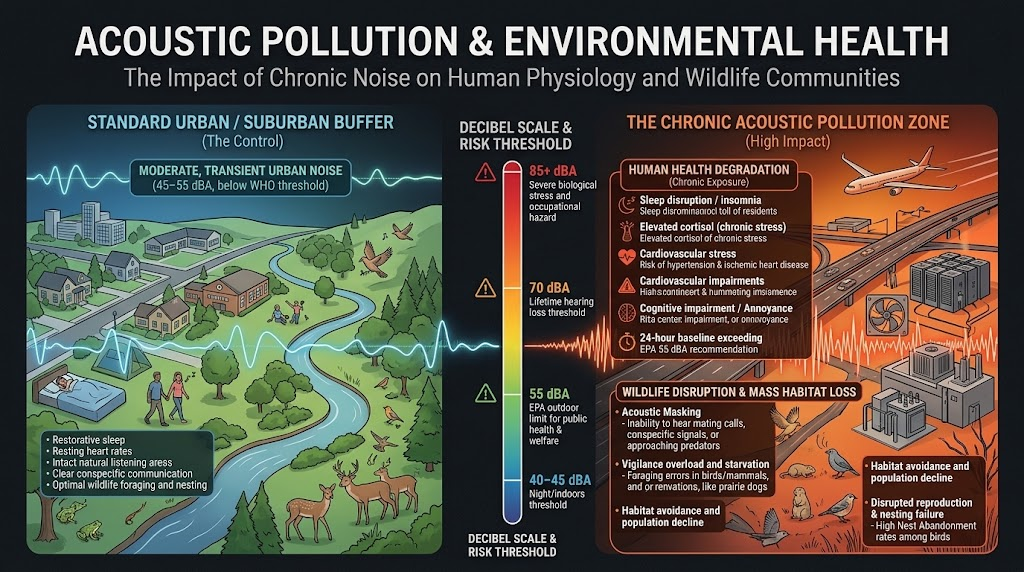
Data center environmental reviews routinely hide the severe acoustic impact of high-density cooling infrastructure:
- Infrasound and Low-Frequency Noise (LFN): Evaporative chiller cooling towers, massive air-handling units (AHUs), and variable-frequency fans produce continuous acoustic signatures below 250 Hz, with significant infrasonic components under 20 Hz.
- Acoustic Cavitation & Structural Resonance: Unlike high-pitch mechanical noise, low-frequency pressure waves bypass standard tree-line buffers, ground berms, and residential building envelopes. Long-term exposure to persistent low-frequency hums induces sleep disturbance, vibroacoustic stress, and chronic autonomic nervous system fatigue in surrounding neighborhoods while disrupting local avian and wildlife navigation.
5. Meteorological Vulnerability: 10-, 50-, and 100-Year Precipitation Surges
Rhode Island’s updated climate precipitation models confirm that historical 10-, 25-, 50-, and 100-year storm frequencies are breaking legacy stormwater design standards:
- Hydraulic Overload of Retention Basins: Standard civil engineering retention basins sized on outdated historical NOAA Atlas 14 rainfall data cannot buffer modern high-intensity convective rainfall.
- Catastrophic Perimeter Flushing: During an extreme storm event, overloaded retention systems will breach, flushing hot retention water, suspended industrial particulates, and petroleum traces from backup generator staging areas directly into adjacent wetlands and municipal aquifers before settling can occur.
6. The “Parasitic Infrastructure” Reality
Hyperscale data facilities increasingly target semi-urban and suburban peripheries for convenient proximity to municipal water lines and high-voltage transmission rights-of-way. In exchange, they deliver virtually zero local economic circulation, negligible permanent employment (often fewer than 20 on-site staff), and massive systemic drain on local resources. The infrastructure operates as an extractive, localized liability rather than a municipal asset.
Section 5: Structural Non-Viability on Terrestrial Acreage, Strategic Offshore Alternatives, and Aviation Interference Risks
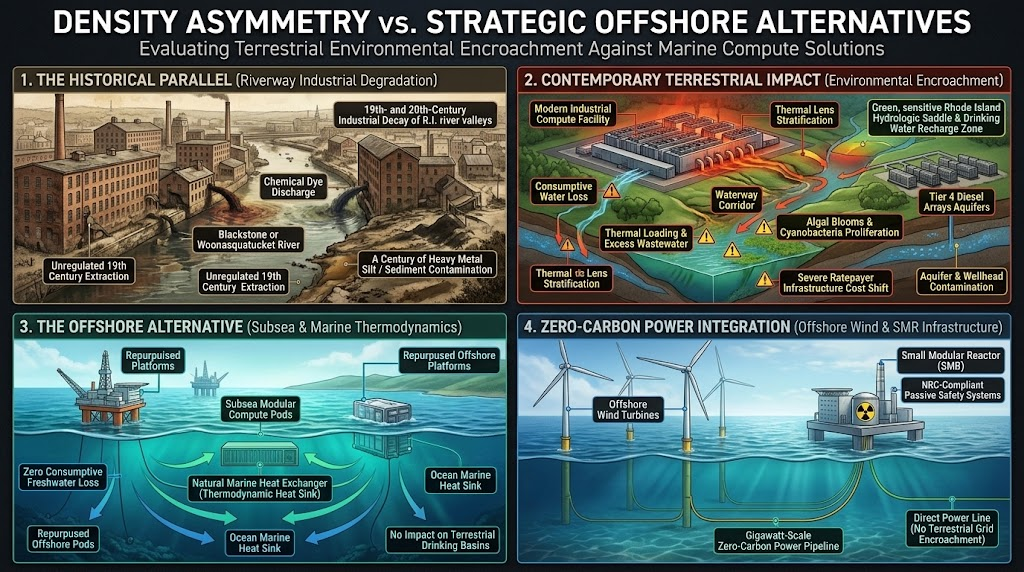
1. Density Asymmetry and Historical Environmental Parallels
In a geographically compact state with high population density radiating in every direction, dedicating terrestrial acreage in sensitive recharge zones to heavy-compute infrastructure represents an unsustainable land-use model:
- Repeating Industrial Extraction Patterns: Granting zoning variances and expedited site permits without comprehensive multi-season baseline studies mirrors the 19th- and 20th-century industrial degradation of the Blackstone and Woonasquatucket river valleys. A century ago, mill complexes turned regional rivers into open chemical discharge ditches; today, unvetted high-density compute risks replacing dye pollution with persistent cyanobacteria blooms, heavy metal runoff, and diesel contamination over critical drinking water aquifers.
2. Viable Alternative Architectures: Offshore Siting and Marine Heat Sinks
Rather than consuming terrestrial municipal watersheds and overloading localized electric substations, utility-scale data architecture should align with regional offshore assets:
- Marine Thermodynamics vs. Aquifer Evaporation: Deploying compute clusters on repurposed offshore infrastructure (such as decommissioned platforms or marine modular pods) leverages the ocean as a virtually infinite heat sink. Subsea and marine heat exchangers eliminate consumptive freshwater loss, avoid local thermal lens stratification in shallow ponds, and completely remove thermal pollution from municipal drinking basins.
- Direct Offshore Wind Integration & Small Modular Reactors (SMRs): Rhode Island already leads in offshore wind development. Coupling high-density loads directly to offshore wind transmission lines or next-generation Small Modular Reactors (SMRs) insulates the terrestrial grid. Modern Gen-IV SMR designs feature passive safety systems that physically prevent loss-of-coolant meltdowns under NRC regulations, generating localized, zero-carbon gigawatt-scale power without burdening municipal ratepayers or encroaching on residential zones.

North Central State Airport
3. Electromagnetic Interference (EMI) and Avionics Hazards: North Central State Airport
The proposed Route 116 corridor lies directly within the terminal approach and departure environment of North Central State Airport
- High-Energy Electromagnetic Interference (EMI): Multi-megawatt substations, high-voltage switchgear, massive variable-frequency motor drives (VFDs), and dense switching power supply arrays generate wideband electromagnetic fields and harmonic distortion.
- Navigational Degradation & Instrument Approach Risks: Unmitigated EMI introduces acute interference risks to VHF Omni-Directional Range (VOR) beacons, Instrument Landing System (ILS) localizer/glideslope signals, and GPS/WAAS satellite acquisition. Any signal corruption risks blinding cockpit avionics during low-visibility operations, stripping pilots of precision instrument guidance and forcing emergency Visual Flight Rules (VFR) transitions in restricted airspace. A comprehensive Federal Aviation Administration (FAA) Part 77 airspace evaluation and rigorous EMI radio frequency propagation study are mandatory before any structural approvals can proceed.
4. Conclusion & Regulatory Mandate
The proposed Smithfield data center cannot achieve “ecological neutrality” under current site parameters. Placing continuous thermal, electrical, acoustic, and chemical burdens across an environmentally stressed hydrologic saddle creates significant long-term municipal liabilities while delivering negligible civic value.
The Town Council, Planning Board, and the Rhode Island Department of Environmental Management (RIDEM) should decline all requested zoning amendments and special use permits until:
- A multi-agency Environmental Impact Statement (EIS) under RIDEM and USACE oversight is completed, explicitly modeling thermal discharge against 2026 cyanobacteria advisory baselines.
- An FAA/FCC Joint Electromagnetic Compatibility Study verifies zero interference with North Central State Airport
- The developer executes a binding, non-recourse infrastructure bond fully indemnifying municipal ratepayers and local fire districts against grid upgrades, hazardous materials equipment procurement, and catastrophic secondary containment failure.
Addendum: Technical Specifications for Offshore Siting, Infrastructure Isolation, and Marine Thermodynamic Alternatives
A.1 Thermodynamic Decoupling & Closed-Loop Marine Heat Exchangers
- Elimination of Freshwater Evaporative Losses: Transitioning high-density compute clusters from terrestrial recharge zones to marine platforms utilizes open-ocean water bodies as near-infinite thermal sinks, operating via titanium plate closed-loop secondary heat exchangers.
- Aquifer & Recreational Buffer Preservation: Moving thermal dissipation offshore prevents the discharge of millions of BTUs into fragile inland swales, eliminating the surface thermal stratification that accelerates cyanobacteria blooms in shallow water bodies (e.g., Georgiaville Pond, Stillwater Reservoir) and protecting municipal wellhead recharge areas from thermal-jet disruption.
- Subsurface Hydraulic Protection: By avoiding artificial thermal gradients on land, regional groundwater temperatures remain stable, eliminating the thermodynamic triggers that increase the solubility, unbinding, and accelerated migration of legacy contaminants from upstream and downstream Superfund corridors (such as the Centredale Manor restoration zones).
A.2 Independent Microgrid Architectures (Offshore Wind & SMR Integration)
- Direct High-Voltage Interconnection: Colocating compute facilities with offshore wind transmission corridors or deploying dedicated Generation-IV Small Modular Reactors (SMRs) insulates the local sub-transmission system from severe industrial load steps.
- Grid Decoupling & Ratepayer Protection: Siting generation and compute offshore prevents non-coincidental base loads from entering ISO New England’s constrained Rhode Island delivery corridors. This stops utility rate-base socialization, ensuring residential and commercial ratepayers do not subsidize 115 kV line rebuilds, substation upgrades, or transmission tariffs.
- Passive Safety Architecture: Modern SMR installations operate under strict NRC design parameters featuring passive, gravity-driven cooling systems. These systems maintain core stability without reliance on off-site AC power, eliminating terrestrial diesel belly-tank fuel farms and associated groundwater contamination risks.
A.3 Hazard Containment & Municipal Liability Insulation
- BESS Isolation: Battery Energy Storage Systems (BESS) and high-voltage Class C electrical gear deployed on maritime structures contain thermal runaway hazards within isolated structural cells equipped with automated seawater deluge and inert gas suppression (e.g., Novec/Inergen).
- Zero Municipal Fire District Burden: Removing specialized industrial electrical hazards from small municipalities eliminates unfunded mandates for volunteer fire departments, removing the need for costly HAZMAT mutual-aid equipment, foam tenders, and advanced high-voltage training programs.
- Deterministic Workload Management: Incorporating dynamic power-signature workload shaping allows operational priority to be directed toward high-value scientific and public-interest compute pipelines while automatically throttling non-essential extraction loads during periods of grid or resource stress.
“Methodology Note: All hydrological data, spatial mapping, and infrastructure parameters were independently compiled and verified by the author. Large-language model tools were utilized strictly for text structural formatting, synthesis, and typographical composition as an assistive interface.”
“Operational impact parameters and resource draw baselines reflect empirical, multi-facility operational averages derived from established high-density compute corridors rather than non-binding applicant design estimates.”
McDonalds introduces dynamic pricing while owner is still dynamically gagging over burger.
The idea of dynamic pricing baffles me. The fact that big corps are trying this to extract more money out of consumers should be illegal. Unless dynamic pricing follows the consumer.
McDonald’s is increasingly using artificial intelligence to guide menu prices across the U.S. and some global markets, a plan that aims to boost headquarters’ profit but risks alienating customers and attracting antitrust scrutiny. One pricing factor supercharged by AI: an estimate of how much each store’s patrons are willing to pay.
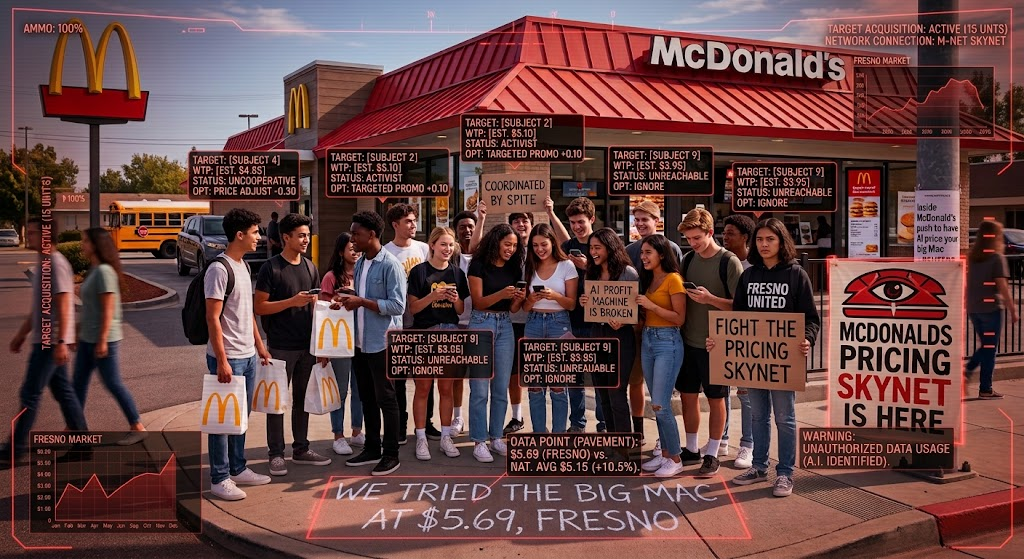
Consumers at first will not take this lying down, I have seen dynamic pricing and the fact that this is being done by AI makes it a bit funny. the factor is that AI doesn’t understand why people are buying something. So what happens if a group targets a low priced item on a menu for a few months and then pulls the rug on said product, it would create an AI model in a panic. AI is good at dealing with averages… give it an outlier and it does not know what to do.
The details of how that pricing system works, its extensive use of AI, the company’s regulatory concerns and the tensions with its franchisees haven’t been previously reported. For this story, Reuters reviewed screenshots of the company pricing engine taken in August and interviewed nine sources with first-hand knowledge of the burger chain’s strategy. McDonald’s pricing engine uses machine-learning algorithms to continually analyze data from millions of daily transactions across McDonald’s nearly 14,000 restaurants and generate what the company calls “the optimal price” at each location for each menu item, from Big Macs to discounted coffee for seniors.
They think they are being clever to drive a few pennies of profit out of customers, the problem here is this is McDonalds which already has earned its way into common language as a McJob. Given that if they spite enough customers, they will revolt and it wont be pretty. One post to a website and a bit of patience people can turn an AI profit machine into gaming the system until it crashes.
A Reuters check of prices in September on the McDonald’s mobile app showed price differences. For example, a company-run store in Fresno, California sells a Big Mac for $5.69, but another company-run restaurant two miles away sells the same sandwich for $6.89, a 21% premium.
The other thing right here is again playing with fire. What’s to stop a person from buying from Store A and returning to store B and pocketing the 21% premium. Some frydrone is not going to wait around while someone is trying to fish up a receipt on a still warm meal.
In January, McDonald’s started requiring franchisees to be “constructively engaging with McDonald’s approved Pricing Consultant and Tools” as part of its new business standards, according to an internal communication sent to franchisees and reviewed by Reuters.
As I stated in beginning AI is good to be an average at things, but once you start adding outliers to the model like a stores finance model shows and uptick in cheeseburgers to the point of near absurd and other stores show a drop because people are spiking the model the AI is going to say to increase the price and once that happens suddenly cheeseburger purchases not only drop from the price increase but people manipulating the prices stop screwing with the AI McDonalds corporate is going to panic because the AI modeling of the price is showing to be failing. In all honesty to guide a model like this it would not take very many extra purchases in a day to corrupt sales data 100 cheeseburgers would be enough to throw a model off. Once people start poisoning the sale model it has some pretty bad outcomes.
First the store sees the sales spike, The AI and Store manager see it and start carrying more of that product. The problem here is product in a store like this is perishable. if the rug is pulled a month later you have a store manager stuck with product rotting losing money, You have pissed off consumers stopping going to that store which creates more wasted product and the manager is stuck with his hat in his hands because the machine told him to buy something that no one could see.
If McDonalds was an isolated store in a tube this would not happen but go to google maps and go to any city and type McDonalds , you will have 3 to 5 in 2 minutes driving distance of each other. McDonalds wants profits and they are instead are going to get a model collapse because in the US you basically have 5 minutes in any direction to a McDonalds and consumers that are easy to spite.
Here is a map where I picked a random area just because it’s random and it shows the exact issue I said.

Examples of McDonald’s parameters for the price engine included, according to the two employees: focusing increases on menu items that have not had a price increase in at least two years; only increasing prices on items that have had recent price increases in at least 30% of stores; excluding ice creams and drinks from price increases during summer months.
Lastly McDonalds mapped out the whole game here. Not only are they exposing the weakness here they are making this exploitable to the point where a group of 20 people could cause profit rot on multiple store in an area and McDonalds reliance on the AI Magic Machine will cause damage to no end of the franchisee. Also as I have said before model rot can come unintentionally if a school bus from a class trip comes in for a week it will cause massive model issues. They will buy too much and too little stock in order to balance out an AI that sees a jump in sales because of a class trip.
Update! The Legal McHammer Drops:
Well now.. It’s as if On October 2, 2026, a nationwide class action lawsuit dropped and the company is alleged to have violated Section 1 of the Sherman Antitrust Act. The lawsuit claims McDonald’s took non-public transaction data to run an algorithmic price-fixing ring across independent franchisees. McDonald’s tried to say “AI does not set the price of a Big Mac.” Sound familiar? Sounds like when the CEO said he “loved” their product.. When you try to force independent franchisees to feed an AI engine so it can coordinate price hikes down to the penny, it isn’t smart retail. it’s an automated crime posing as AI.

McDonalds has ensured that the McJob stays exactly what it is, they are letting a machine that does not have the instinct to run the numbers and see why sales are what they are. A worker who sees two buses pull up will throw extra fries on and know exactly why he did that. AI can’t see the bus pull up and causes the price to jack up a week later because a School play was in a theater for 2 weeks. The worker knows that there was a play by intuition, The AI only sees higher than normal purchase rate. This is why for the same reason 20 people with a few dollars and being bored can cause a store to lose thousands. Again corporate greed and their belief that AI is magic is going to be the downfall.
Welcome to McFelonies would you like Fries with that?
Attributions from:
Yahoo! Finance: Inside McDonald’s push to have AI price your Big Mac
Reuters.com: McDonald’s hit with class action alleging AI-powered menu price-fixing