Wall Streets Debit cards starting to reject on AI stocks.
Investors are starting to look at their credit card bills and realize that spending on something that might not pay back might not be the best idea.
Wall Street appears to be hitting its limit on AI, and financiers are starting to say the quiet part out loud: All of this AI spending doesn’t look like it can pay off, at least not for everyone.
The run on AI stocks is hitting its peak, with the markets being in a weak position and the investors jumping on get rich quick schemes for AI.
While AI providers are projected to spend $7 trillion on infrastructure through 2030, research from Gartner forecasts they will generate no more than $3.6 trillion in related revenue over that same period.
More than $4 trillion in AI infrastructure spending could be at risk of write-downs by the end of 2032 if companies maintain their current investment pace.
Anyone see a problem here? If not let me help you $7,000,000,000,000! That’s enough to give every man woman and child in America about $20,000 each! And wait there is more , due to the US gov they are hooked into this too by at the very least 10% , You might say that is good.. well I have something to tell you.. its bad. Because before when a company fucked up they would either be bought up and sold off. So what happens when a company doesn’t own compute but however rents it.. Effectively selling electrons. it’s worth zero. But back to the US government’s interests in AI companies* if the company goes tits up it means the US will be the one to take the debt and not just the 10% but likely much much more because its interests are to make money from the piece of the pie they own.
Case in point: CoreWeave, one of the largest neoclouds with among the closest ties to Nvidia — the AI boom’s financial and spiritual foundation — has faced a multiday sell-off of its stock and debt. Yields pushed above 15% and its stock tumbled 15.5% before rebounding after Nvidia CEO Jensen Huang spoke up on the company’s behalf.
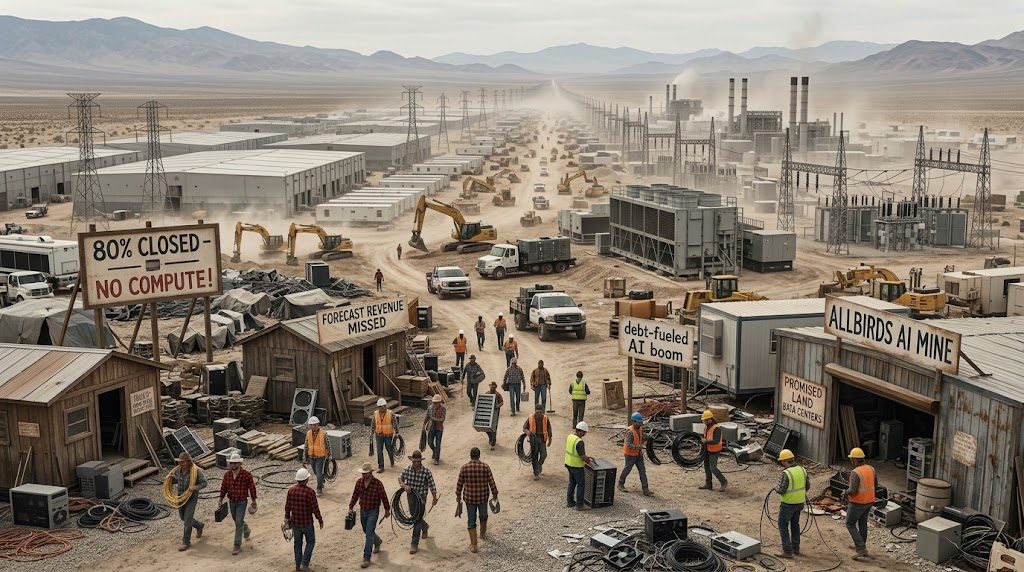
Nvidia has a ravenous appetite for AI right now and I will say one thing for Jensen Huang, The man owns stock in CoreWeave. Also when the stock went low Jensen Huang did buy up more stock . This is theatre and they know it . The AI gold rush is in full bloom and people are making their AI mines in every surface they can. The problem is there are AI mines that do not even own a fucking thing. Look at AllBirds they sold their entire shoe company down to a name screamed to the masses they are an AI company and investors jumped the claim thinking all birds was going to be the next big AI thing.
Zoom in: The constant spending relies on the belief that compute demand will never falter — a belief that has structural cracks.
Reflection AI co-founder Ioannis Antonoglou told Semafor that businesses may need “a decade or two decades” to fundamentally redesign their operations around AI.
That’s 10 to 20 years of companies slowly adopting the technology that’s being built (expensively) today.Between the lines: This creates a mismatch: Data centers and chips require enormous investment today, but the returns that could justify that spend will take years to materialize.
Here’s the thing, These data centers are a scam, Everyone knows it, No one wants to admit it. The prompt in an AI to make a chicken that farts and flies away in a 5 second clip is enough to make a few pots of coffee. So when a developer says “the Data Center will only cost $50 Million to construct.” its very constructive wording! Sure you have the $50 million dollar data center but on top of that the city will have to make a $40 million investment in water supply improvements , The power company will have to either import $50 million in power a year or build out 2 to 4 power plants at $400 million.. Otherwise brownouts in the town lead to consumer electronics shortening their lives, Life saving equipment starts taking hits from an unclean power supply, the cost in general goes up for electricity $20 to $40 million and the costs do not stop there.
Reality check: Look at Anthropic’s latest financials for a counterpoint to the bears. The company is raking in cash, turning free cash flow positive in the third quarter and growing revenue nearly 50% compared to the April-to-June period.
But even Anthropic’s staggering growth has slowed, albeit expectedly because trees can’t grow to the sky.
Anthropic’s game here is cooking the books, LLMs are shifting CapEx building to the other set of books, these companies are saying we are profitable but do not look at the other set of books that the CPA is holding.
The bottom line: The debt-fueled AI buildout is not an isolated problem for tech investors alone to worry about. The stock market and economy have become increasingly tied up with the AI boom.
If the AI bet doesn’t work, markets and the economy could falter as well.
The problem here is when everyone is building and no one is paying attention to who is building and suddenly you have a mega city that only has 150,000 people and the city supports 50,000,000 you have a major problem on your hands. Data Centers can’t be easily converted to other uses, it is not like an office building where you can go to IKEA and do a furniture refresh and have the building up and going in a week. So as I say the AI goldrush is going to have tons of mines that had no productive output and the companies that made them are going to crash and burn and go out of business and drop the problem on the city that hosts the datacenter.
Note on US Government Exposure: This isn’t just about direct public equity stakes; it’s about systemic exposure. Between CHIPS and Science Act loan guarantees, direct federal research subsidies, and the federal backstopping of commercial banks (like JPMorgan and Citi) underwriting tens of billions in leveraged data center loans, the public balance sheet is already holding the bag. When these speculative neoclouds and GPU-backed facilities enter distressed territory, the downside risk rolls straight downhill to the taxpayer.
Attributions from:
AXIOS – The debt-fueled AI boom is cracking